
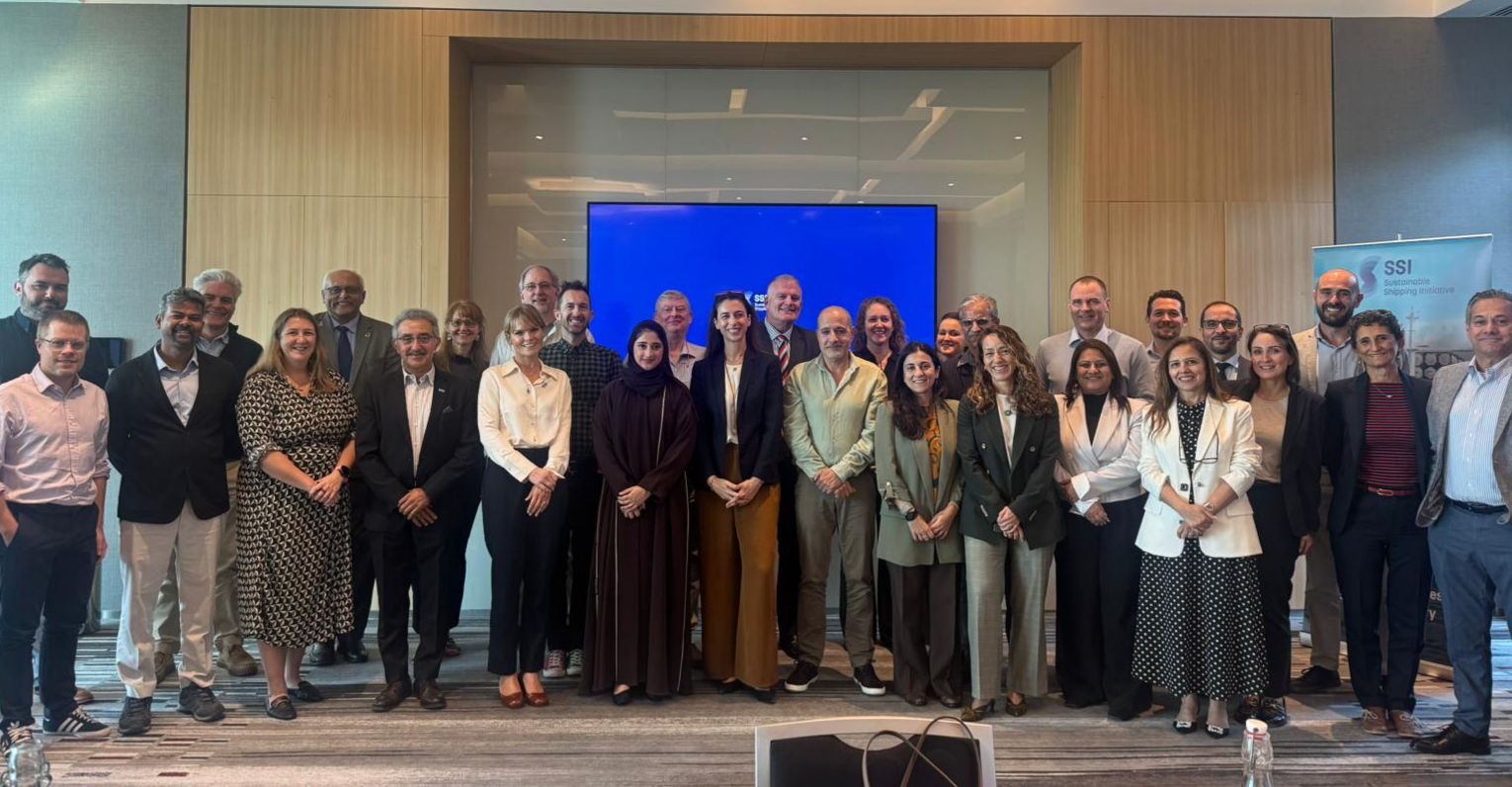
As part of the Sustainable Shipping Initiative Global Members’ meeting in the UAE, the MENA Oceans Initiative by Goumbook convened a select group of regional maritime leaders, policy experts, conservationists and scientists for a Regional Industry Roundtable. The dialogue enabled an exchange of strategic insights between global shipping sector and regional entities, highlighting key strategic considerations that would facilitate the development of implementation roadmaps as stakeholders in one of the world’s most consequential maritime corridors, along with progress on biodiversity and ocean health KPIs.
The Regional Industry Roundtable
The Regional Industry Roundtable brought together maritime leaders, government officials, NGOs, financiers, academics, and innovators. Hosted at the SSI Global Members’ Meeting, the session was structured around two interlocking themes: maritime decarbonisation and the realisation of ocean co-benefits, including biodiversity, coastal resilience, and blue economy value.
With approximately 12% of total global trade and just under a third of global container traffic passing through its key waterways, the MENA region sits at a key crossroads of the global shipping system, making Abu Dhabi a fitting backdrop for this dialogue.
Participants shared case studies from around the globe, from living seawalls in Peru to shore power incentives in Vancouver, from mangrove regeneration in Fiji to digital marine monitoring systems out of Norway, alongside candid discussion of the investment risks, policy gaps, and monitoring challenges that slow these efforts down. Despite clear regulatory direction, several participants noted the risk of fragmentation: each actor solving their own piece of the puzzle without the cross-sector coordination needed to avoid stranded assets, duplicated effort, or misaligned timelines.
The conversation also examined what aligned action might look like in practice:
pre-competitive collaboration between ports and shipping lines on infrastructure investment; traceable KPIs that satisfy both investors and regulators; and nature-positive outcomes embedded in decarbonisation strategy from the outset, not appended as an afterthought.
Strategic Inputs
The day before the roundtable, SSI’s Ocean Working Group met to examine the practical implications of the IMO’s Marine Environment Protection Committee session – MEPC 4 – Energy Efficiency Measures. The group focused on identifying where these outcomes create real opportunities for progress, and how commercial uncertainty, when aligned with incentive strategies, and the development of credible baselines for ocean co-benefits will enable action.
The Regional Roundtable drew on inputs from this Working Group, and advanced discussion on the core framework central to this work – the Marine Biodiversity and Ocean Health Roadmap, developed by the MENA Oceans Initiative and core partners SSI, the Climate
High-Level Champions, and the United Nations Foundation, under the MENA Maritime Programme as part of the 2030 Maritime Breakthrough Goal, sets out specific near-term actions and milestones for the maritime sector, anchored by a target to reduce shipping’s impact on marine biodiversity by 30% by 2030. SSI’s Roadmap to a Sustainable Shipping Industry, organised around six vision areas – People, Communities, Finance, Transparency, Energy, and Oceans – provides the broader framework through which stakeholders across the value chain can direct efforts and review progress.
What Comes Next
With the tools, frameworks, and political will to act on maritime sustainability finding stronger alignment; participants identified the need for more data sharing, consolidation of use cases, and more structured platforms for ongoing exchange. These conditions would enable the creation of evidence based business cases that can accelerate the uptake of biodiversity and resilience measures within core operational strategies by shipping and port stakeholders.
The MENA Maritime Programme supports the regional delivery of the Maritime Breakthrough goals; in its Phase 2 (January – December 2026), the Programme will continue to convene these dialogues, building on this session’s solution‑oriented dialogue to enable capacity building with the following key objectives:
- socialise the Marine Biodiversity and Ocean Health Roadmap and SSI Stakeholder Guidance with stakeholders across the region to support an understanding of how to embed this tool in context
- advance the Resilience for Ports (R4P) roadmap in partnership with the International Coalition for Sustainable Infrastructure (ICSI) – inviting ports to conduct climate risk assessments to start establishing globally coordinated baselines
To know more about the programme and how these roadmaps can be embedded within your organisational workstreams, please email: menaoceans@goumbook.com
