
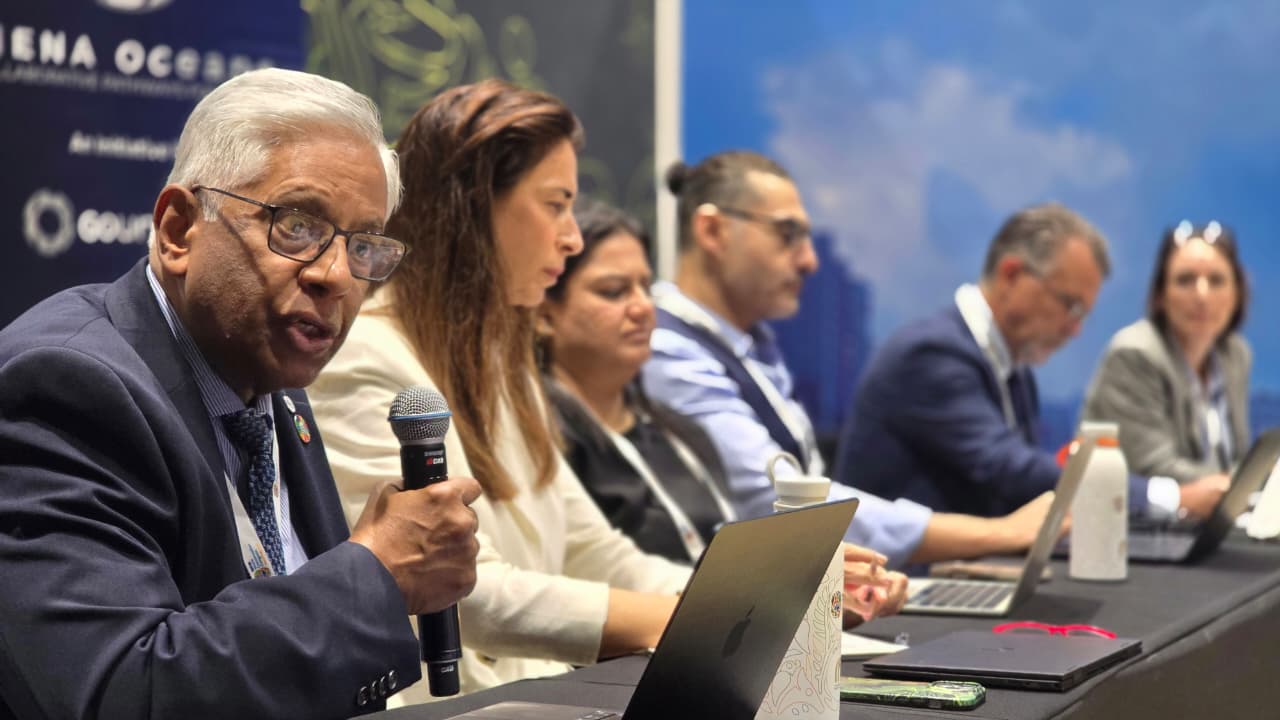
Contributed by Dr. Kilaparti Ramakrishna Senior Advisor to the President and Director on Ocean and Climate Policy, Woods Hole Oceanographic Institution
The year 2025 marked a pivotal shift in the global ocean–climate agenda. The ocean is no longer viewed as peripheral, but as central to climate stability, food security, and sustainable development. Ocean-based mitigation and adaptation are increasingly embedded in national climate plans, from blue carbon and coastal resilience to offshore renewable energy and decarbonised shipping. Momentum behind implementation of the BBNJ Agreement, alongside stronger alignment across climate, biodiversity, and pollution agendas, signals a more integrated response to the triple planetary crisis. Ocean finance is also gaining traction, with development partners and multilateral institutions increasingly treating the ocean as an investable priority.
Against this backdrop, the MENA region emerged in 2025 as both vulnerable and visionary. Discussions at the IUCN Congress in Abu Dhabi highlighted a growing recognition that the ocean must be elevated within national climate and development strategies, particularly in coastal resilience, ecosystem protection, sustainable fisheries, and blue economic diversification. The region is also strengthening its role as a convener, linking science, policy, and finance while expanding ocean observation, research, and data systems to better understand coral resilience, marine pollution, and coastal change.
I had the honor of engaging with regional and global stakeholders across three sessions of the MENA Oceans Summit 2025 within the IUCN Congress, including the MENA Governance and Policy Roundtable and dialogues on maritime decarbonization and delivering the Ocean Breakthroughs. The discussions focused on how the region could carry forward commitments from Abu Dhabi to COP30 in Belém and help ensure that the ocean becomes integral to global climate ambition and implementation.
I left deeply encouraged by the determination, clarity, and collaborative spirit across the region. While MENA faces disproportionate ocean and climate pressures, it is increasingly positioned to lead, advancing solutions in sustainable shipping, regenerative blue economy transitions, coastal resilience, and ecosystem restoration. Three initiatives are already helping chart this course, the MENA Oceans Initiative, the Sharjah Marine Science Research Centre at the University of Khorfakkan, and OceanQuest at King Abdullah University of Science and Technology, demonstrating how science, innovation, and regional cooperation can translate ambition into action.
A defining message from the Summit was the centrality of equity, partnership, and inclusive capacity-building. Participants stressed that meaningful progress requires stronger support for developing countries, improved access to finance and technology, and recognition of regional leadership. The MENA experience shows that solutions forged under constraint can illuminate pathways for other developing regions facing similar challenges.
Looking ahead, 2026 must become a year of convergence and delivery. The growing alignment across climate, biodiversity, and ocean governance must translate into measurable implementation, in ecosystems restored, communities protected, and emissions reduced. The evolving UN reform process presents an opportunity to better integrate the ocean into the global architecture for climate, development, and resilience. As the international community moves beyond ambition toward execution, the journey from Abu Dhabi to Belém, and onward, can help anchor the ocean firmly at the heart of climate action for the Global South and the world.
