
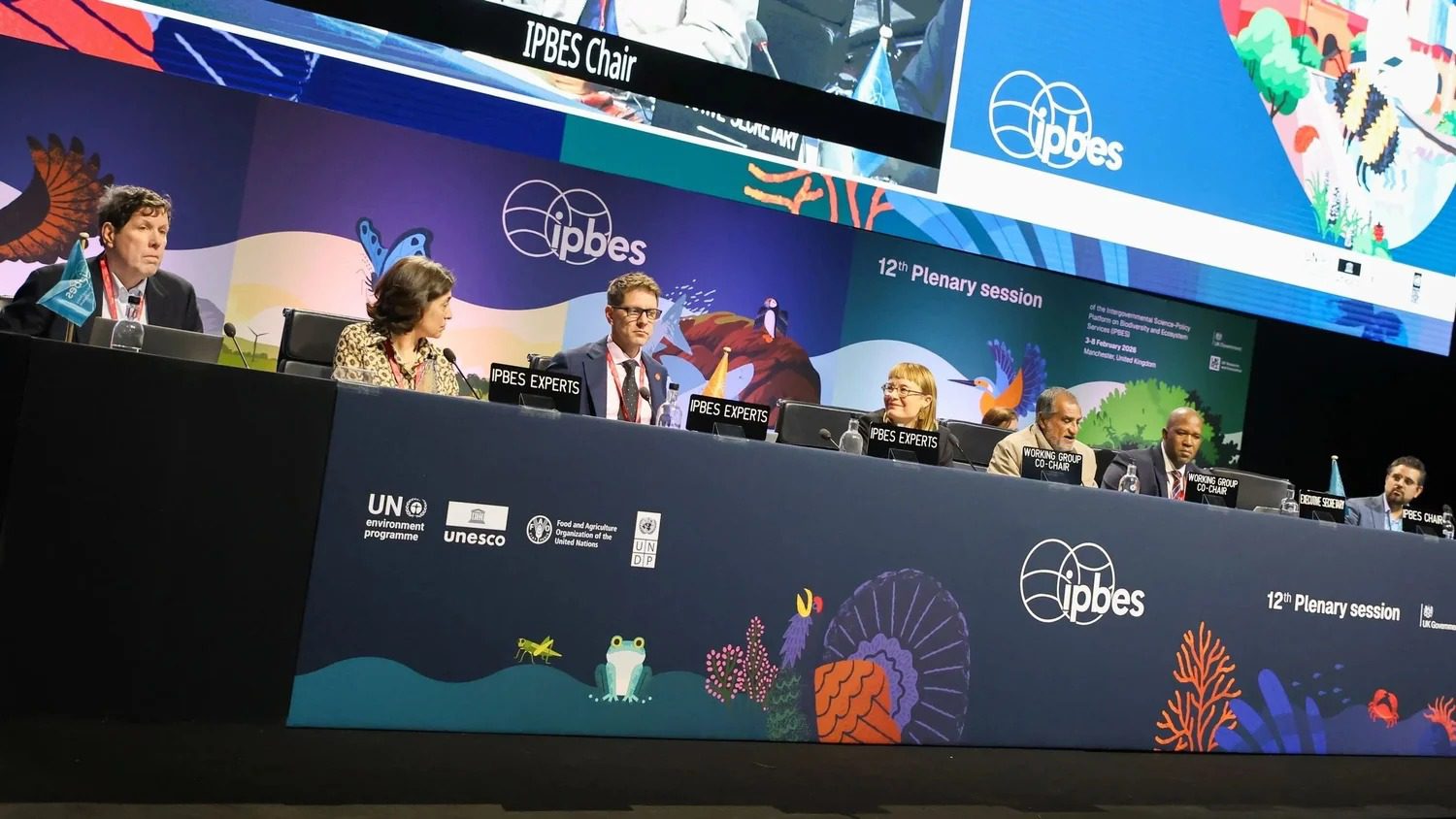
A landmark report quietly published in February 2026 has implications that are anything but quiet. Approved by representatives of more than 150 governments at the 12th session of the Intergovernmental Science-Policy Platform on Biodiversity and Ecosystem Services (IPBES) in Manchester, the Business and Biodiversity Assessment is the first-ever comprehensive scientific evaluation of how businesses both depend on and impact nature, and what that means for risk, strategy and survival.
Three years of work by 79 leading experts from 35 countries, drawing on over 5,000 sources, the report delivers a verdict that should land firmly on the desk of every CFO, board director and sustainability officer: biodiversity loss is no longer a peripheral environmental concern. It is a systemic financial risk.
The numbers are clear
Between 1820 and 2022, the global economy grew from $1.18 trillion to $130.11 trillion (measured in 2011 constant dollars). Business drove that growth. But the cost was steep and unevenly borne. In the past three decades alone, human-produced capital increased roughly 100% per capita while natural capital, the ecosystems and living systems that underpin all economic activity, declined by nearly 40%.
The gap between what we invest in nature and what we extract from it is equally striking. In 2023, global finance flows with direct negative impacts on nature reached an estimated $7.3 trillion, comprising $4.9 trillion in private investment and $2.4 trillion in public subsidies to environmentally harmful activities. By contrast, only around $220 billion was directed toward conservation and sustainable use of biodiversity. That is a 33-to-1 ratio working against the natural world, a figure calculated directly from the report’s own data.
All businesses are in this relationship, whether they know it or not
One of the report’s clearest messages is that there is no sector exempt from this reckoning. Agriculture, fisheries, pharmaceuticals, tourism and construction have obvious direct links to nature. But the report is equally emphatic about less obvious sectors: grocery retail depends on agricultural value chains rooted in soil health and pollination; waste management relies on microbial communities; financial portfolios carry exposure to biodiversity risks in every asset tied to the physical world.
The report maps three types of business dependency on nature, material inputs (raw materials, water, genetic resources), regulating services (flood control, climate regulation, erosion prevention), and non-material contributions (cultural and recreational value). Disruption to any of these creates physical risks, transition risks as regulations tighten, and systemic risks as ecosystems approach irreversible tipping points.
The problem is not a lack of methods, it is a lack of action
Crucially, the report is a methodological assessment. It finds that the science and tools to measure business impacts and dependencies already exist. Spatial analysis, life cycle approaches, participatory monitoring, location-based observation, these methods are available and can be matched to different levels of business decision-making, from site operations to corporate portfolios. The problem is uptake.
Fewer than 1% of publicly reporting companies currently mention their biodiversity impacts in annual reports. A recent survey of financial institutions representing 30% of global market capitalisation identified the three main barriers to better practice as: access to reliable data, access to reliable models, and access to scenarios. The science has outpaced business adoption by a significant margin.

An enabling environment, not just individual commitments
The report is clear-eyed about the limits of voluntary action. While some businesses are making genuine progress, current incentive structures are fundamentally misaligned. Profitable business activity routinely leads to biodiversity loss, while biodiversity-positive action rarely generates proportionate financial return. That is not a failure of individual businesses, it is a structural problem that requires structural solutions.
The report identifies five interconnected conditions required for a genuine enabling environment: strong policy, legal and regulatory frameworks; reformed economic and financial systems; evolved social values and norms; better technology and data infrastructure; and expanded capacity and knowledge. Creating this environment is the shared responsibility of governments, financial regulators, civil society, Indigenous Peoples and local communities, and businesses themselves.
Specific actions outlined include eliminating harmful subsidies, mandatory biodiversity disclosure requirements, green and sustainability-linked financial instruments, access and benefit-sharing frameworks for genetic resources, and public investment in biodiversity monitoring and scenario planning.
For agriculture, the stakes are especially high
For sectors where the business-biodiversity relationship is most direct, food, agriculture, land use, the report’s findings are a call for urgent and substantive action. Agricultural value chains sit at the intersection of every driver of biodiversity loss the report identifies: land use change, direct exploitation, pollution, climate change and invasive species. At the same time, agriculture is one of the sectors most acutely dependent on the very ecosystem services it is eroding, soil formation, pollination, water regulation.
The report highlights that smallholder producers and Indigenous Peoples and local communities often bear the greatest costs of biodiversity decline while having the least capacity to absorb or adapt to those shocks. Integrating these communities into value chains, measurement processes and governance decisions is not just ethically sound, it is, the report argues, a condition for accurate assessment and effective action.
The bottom line
Co-chair Matt Jones of UNEP-WCMC framed the stakes plainly: businesses can either lead the way toward a more sustainable global economy, or risk extinction, of species in nature, and potentially their own. This is not hyperbole. The report documents cascading tipping points and feedback loops that could fundamentally destabilise the sectors and supply chains on which global commerce depends.
The tools exist. The evidence is robust. The window for coherent, system-level action is open, but not indefinitely. What the IPBES Business and Biodiversity Assessment offers is exactly what the moment requires: clarity, coherence, and a framework that cuts through the noise to show what meaningful action actually looks like.
