
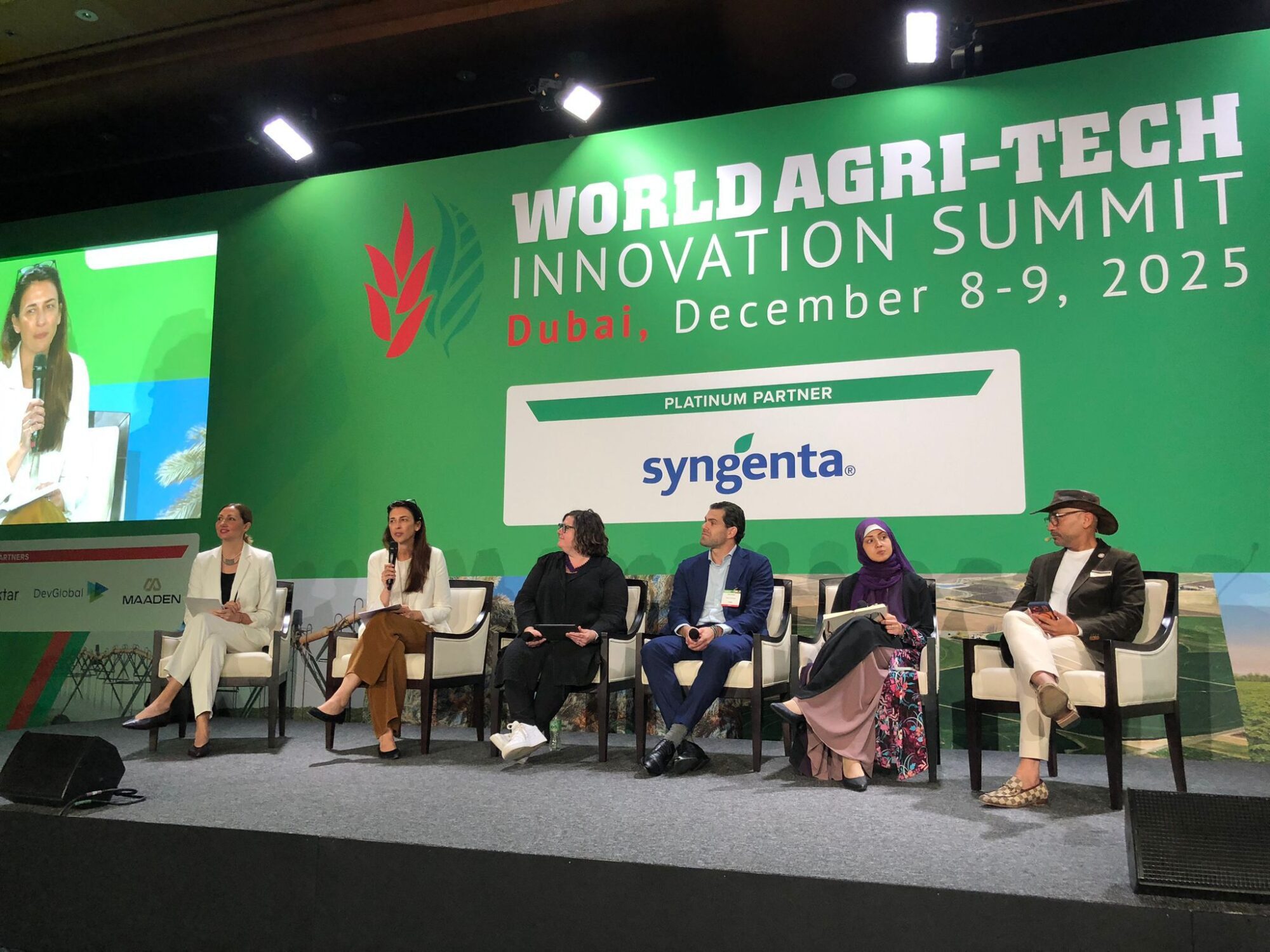
The MENA Regenerative Agriculture Initiative joined global leaders at the World Agri-Tech Innovation Summit in Dubai this December, contributing to critical conversations about climate-smart agriculture and sustainable farming in arid regions.
Tatiana Antonelli Abella, Goumbook’s founder and managing director, participated in the panel “Tech-Enabled Regeneration: The Opportunity for Climate-Smart Agriculture”—exploring how regenerative agriculture Middle East North Africa, supported by data and agriculture innovation, can become scalable, investable climate solutions for combating desertification in semi-arid landscapes.
Key themes covered during the discussion included:
How biochar, no-till, and water-saving technologies are making desert agriculture climate-resilient and commercially viable in MENA; the rise of carbon monetisation, tech platforms, and blended finance to scale regenerative practices; the role of data-driven tools such as remote sensing, soil analytics, pyrolysis, and IoT irrigation in closing efficiency gaps; and the potential for MENA-developed solutions to be exported to other regions facing increasing desertification.
The case is clear: These agriculture innovations are already transforming desert integrated farming across the region. Carbon sequestration through regenerative farming, combined with carbon credits, green finance mechanisms, and agriculture startups, are emerging as critical enablers. Data-driven precision tools are closing efficiency gaps while improving soil health and addressing water scarcity challenges that are limiting dryland farming potential.
Our position: climate-smart agriculture in MENA cannot stop at efficiency. It must restore soil capital, rebuild water cycles, enhance ecosystem services, and remain economically accessible to farmers. Regenerative agriculture, anchored in nature-based solutions and powered by smart technology, offers exactly that, a pathway that simultaneously improves food security, builds climate resilience, reverses soil deterioration, and sequesters carbon at scale.
As desertification accelerates globally, MENA-developed sustainable agriculture solutions have export potential to other regions facing similar pressures. The question is no longer whether soil regeneration works in arid climates, it is how fast we can scale it.
For more information on the MENA Regenerative Agriculture Initiative, click here!
