
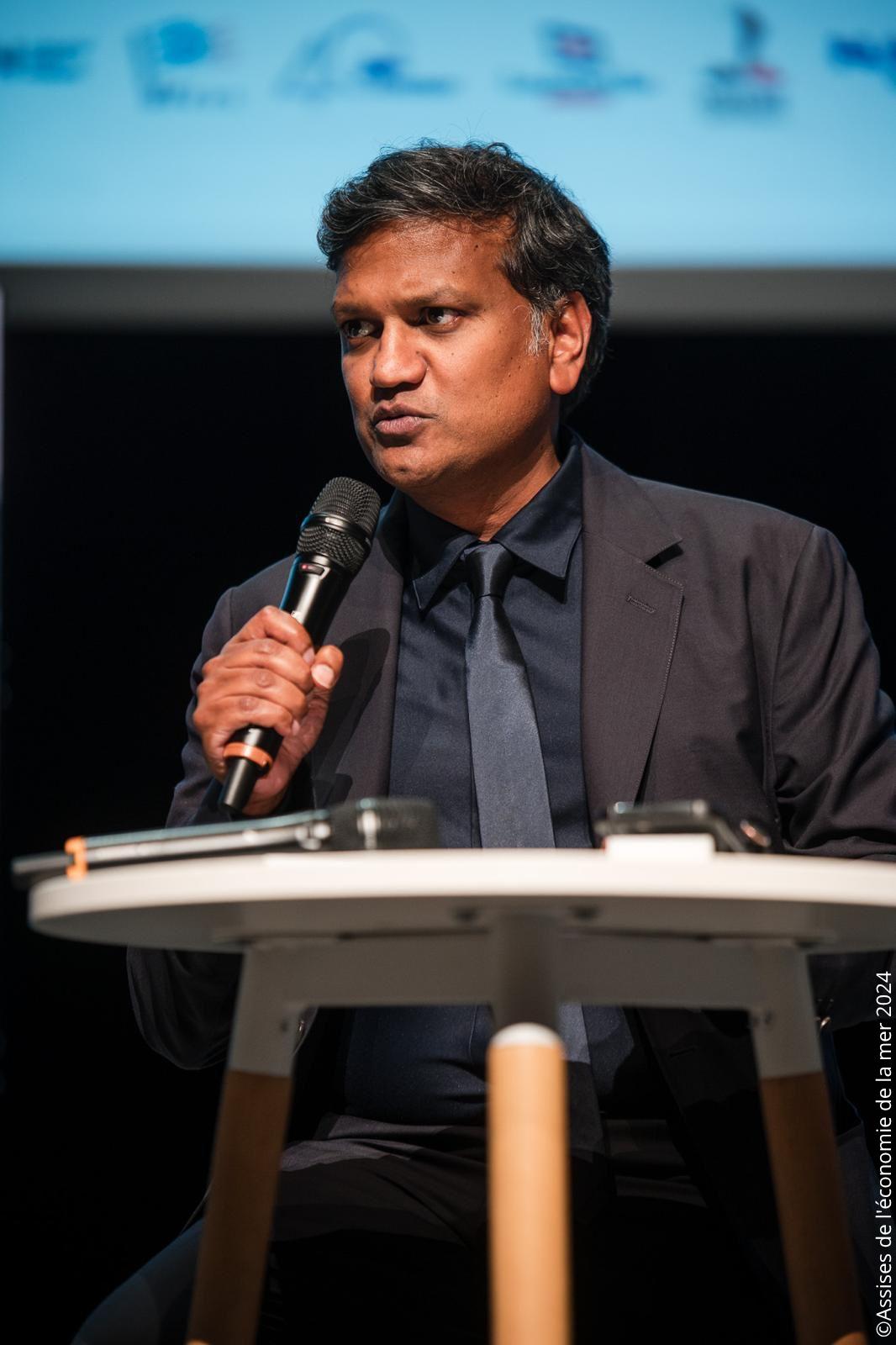
By Ashok Adicéam, Executive Director, Mission Neptune / Deputy Special Envoy for the Ocean (France)
The Ocean has always preceded our systems of power.
Before digital networks, there were oceanic ones. Before global markets, there were currents and trade winds. Today, the Ocean remains Earth’s most powerful planetary system, regulating climate, sustaining biodiversity and underpinning global economic stability.
And yet, it is still largely ungoverned.
This contradiction now sits at the heart of international policy. As states move to implement the High Seas Treaty and deliver on the global commitment to protect 30 per cent of the Ocean by 2030, a simple reality is emerging: we cannot govern what we do not sufficiently understand.
The challenge is no longer only environmental. It is structural. It is about building the knowledge architecture required to manage the Ocean as a global commons.
The European Union is now beginning to recognise this reality. With the European Ocean Pact and the forthcoming Ocean Act, it is reframing the Ocean not only as an environmental priority, but as a system that underpins climate stability, economic resilience and geopolitical balance. This shift is both necessary – and overdue. Because the Ocean is not a sector. It is a planetary system.
This is the premise behind Mission Neptune, launched in the wake of the UN Ocean Conference hosted by France in June 2025 under the Presidency of Emmanuel Macron.
Its objective is not to add another initiative to an already crowded landscape, but to connect what already exists. By aligning scientific programmes, research fleets, data infrastructures and exploration capacities, Mission Neptune seeks to create a shared operational framework for ocean knowledge – one that can directly inform policy and decision-making.
At a time of geopolitical fragmentation and war, this matters. Scientific cooperation remains one of the few domains where collective action is still possible. In this context, science is not only a tool of discovery. It becomes a language of cooperation.
This approach is already taking shape across regions.
The engagement of the United Arab Emirates and the wider MENA region illustrates how regional leadership can contribute to global ocean governance. Positioned at the crossroads of major ocean basins and trade routes, the region faces acute pressures, from warming waters to ecosystem degradation, but also holds significant capacity for action.
Through the University of Khorfakkan and its state-of-the-art Sharjah Marine Science Research Center – recently completed under the vision of His Highness Sheikh Sultan bin Muhammad Al-Qasimi, Ruler of Sharjah, who was the first leader to answer the call for Mission Neptune launched by the French President – and through operational actors such as Jaywun, the UAE’s national research fleet, a regional ecosystem is emerging that combines science, infrastructure and long-term monitoring.
This is precisely the type of alignment needed at the global level and one that Europe itself now seeks to structure through its emerging ocean policy framework, including OceanEye.
Within this context, Mission Neptune is structured around clear priorities: advancing the exploration of deep-sea ecosystems for both discovery and protection, understanding ocean carbon sinks, developing digital ocean modelling and strengthening the interface between science and policy. It also recognises that observation can no longer be fragmented. At the frontier lies the convergence between ocean and space systems – where satellites, autonomous sensors and digital twins allow us to monitor the Ocean in near real time.
The implications are significant. Better observation enables better governance – from marine protected areas to climate resilience strategies and sustainable resource management.
But beyond its operational objectives, a broader shift is underway.
The Ocean can no longer be treated as a sectoral issue. It is a planetary system – one that connects climate, food, trade and security. Governing it requires moving from fragmented approaches to integrated frameworks of cooperation.
This is where initiatives such as the MENA Oceans Summit in UAE in September and the Neptune Forum, convened this year in Paris on June 8 on the World Ocean Day, play a critical role: bringing together policymakers, scientists, investors and civil society to translate knowledge into coordinated action.
The Ocean is not a distant frontier. It is the infrastructure of life on Earth.
If we are to meet our climate and biodiversity commitments, we must learn to govern it accordingly – not as a collection of national interests, but as a shared planetary system.
The alternative would not be only environmental failure.
It would be a failure of cooperation itself.
