
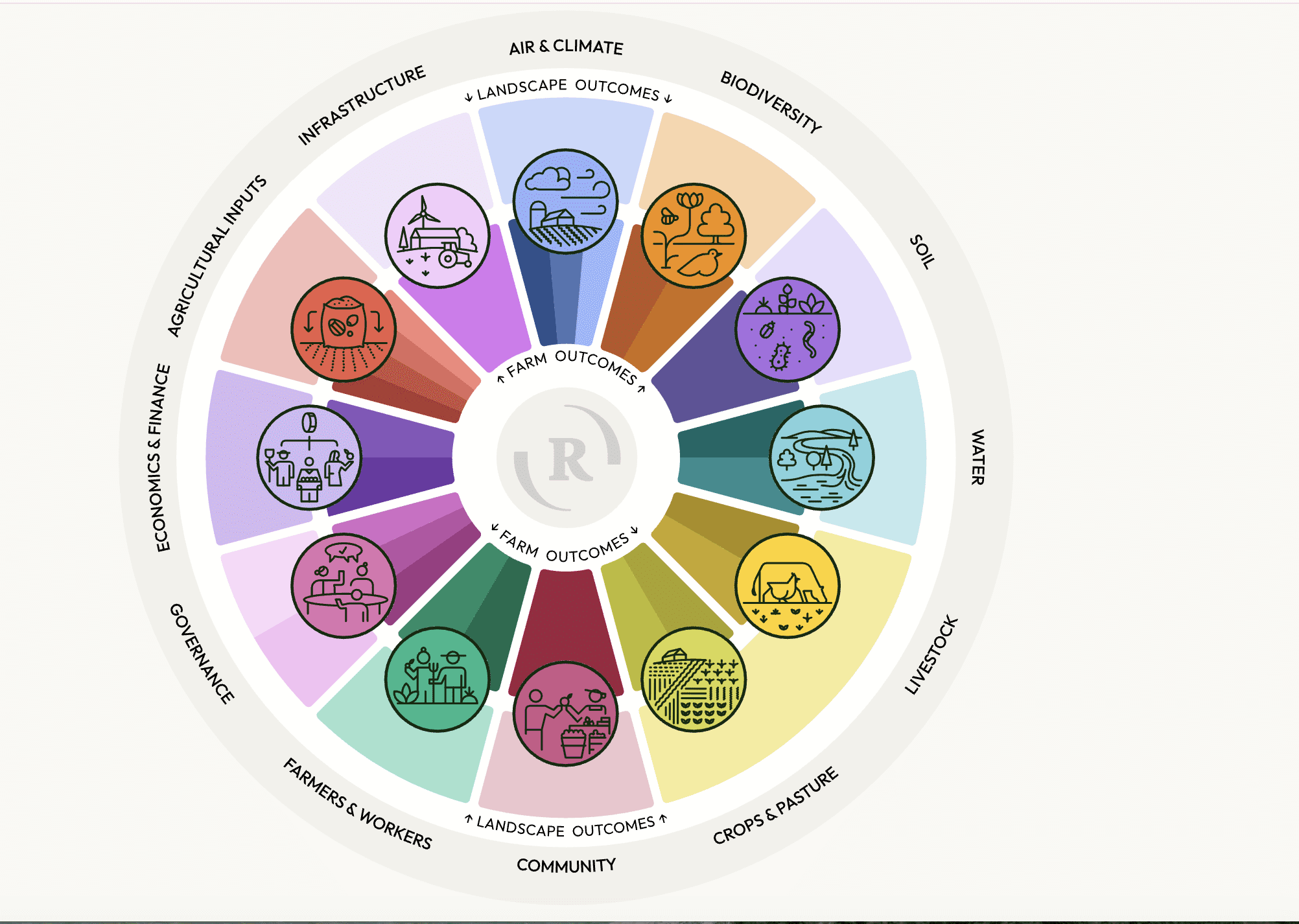
A persistent challenge in the global conversation around regenerative agriculture has been the absence of a shared definition of success. Standards proliferate, certification schemes multiply, and yet diverse actors, farmers, investors, policymakers, food companies, often find themselves working toward vaguely aligned but rarely comparable goals. The Regen10 Outcomes Framework, published in 2026, offers an inclusive response to this challenge.
Rather than specifying which practices farmers must adopt, the Framework defines what regenerative agrifood systems should ultimately achieve. This distinction is consequential. Regenerative practices are inherently context-dependent. An outcomes-based approach accommodates this diversity while still enabling accountability, comparability, and alignment across actors.
Structure and Scope
The Framework is organized around 12 interconnected dimensions: Air & Climate, Biodiversity, Soil, Water, Livestock, Crops & Pasture, Community, Farmers & Workers, Governance, Economics & Finance, Agricultural Inputs, and Infrastructure. Within these dimensions, it defines 25 farm-level outcomes and 12 landscape-level outcomes, each accompanied by illustrative, non-exhaustive indicators.
The two-level architecture reflects an important ecological and social reality: farms do not operate in isolation. Landscape-level outcomes, describing healthy hydrological systems, resilient ecosystems, equitable governance structures, and inclusive economic systems, provide the enabling conditions without which farm-level regeneration cannot be sustained. Conversely, cumulative farm-level outcomes shape the health and resilience of the broader landscape. The framework makes this two-way dependency explicit.
A few dimensions deserve particular attention for the breadth of their ambition. The Governance dimension, for instance, frames inclusive participation, secure tenure, and equitable representation not merely as enabling conditions but as outcomes in their own right. The Economics & Finance dimension explicitly addresses the need for finance that operates on ecological timescales and value chains that do not externalize transition costs onto farmers. The Agricultural Inputs dimension sets a clear directional trajectory: reduced reliance on synthetic inputs, phase-out of highly hazardous pesticides, and integration of inputs into circular systems, with locally adapted cultivars and farmer-selected breeds recognized as central to resilience.
Not a Certification, But a Common Reference
The Framework is clear about what it is not: it is not a certification, an assessment methodology, or a compliance tool. Its purpose is twofold: to create a shared vision of what regenerative agrifood systems mean across diverse actors, and to serve as a credibility reference for standards, assessments, and claims developed by others. In this sense, it functions as upstream infrastructure for the regenerative ecosystem as a whole.
Organizations such as One Acre Fund, LandScale, and Rare have already drawn on the Framework to structure their indicator packages and program designs. SAI Platform’s Regenerating Together Framework and WBCSD’s work on corporate sustainability disclosure provide complementary implementation layers that connect to the Regen10 outcomes architecture.
Relevance for Diverse Contexts, Including Arid Regions
One of the Framework’s notable strengths is its explicit recognition that context shapes both the appropriateness of practices and the relevance of indicators. Indicator selection and measurement methodologies are intended to be tailored to setting, governed by stakeholders, and proportionate to available data and resources. For regions such as MENA, where arid-climate constraints, water scarcity, and traditional land stewardship practices define the agricultural reality, this flexibility is essential. The Framework’s emphasis on locally adapted cultivars, water use efficiency within local availability limits, and the preservation of traditional knowledge systems aligns well with the priorities of regenerative agriculture in dryland contexts.
An Invitation to Align
The Regen10 Outcomes Framework does not ask actors to start from scratch or to abandon existing tools and methodologies. It asks them to align around shared outcomes, and to use those outcomes as a durable reference point for dialogue, design, and accountability across the regenerative agriculture ecosystem.
For farmers and land stewards, landscape coalitions, food companies, financial institutions, policymakers, and technical partners alike, the Framework offers a common language for an urgent and necessary transition.
Read and explore the full Framework: https://framework.regen10.org/about-the-framework
