
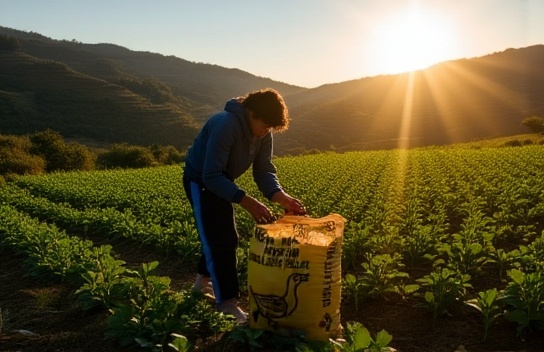
The conflict in Iran is revealing a critical weakness in the global food system: the world’s farmers depend heavily on synthetic fertilisers that travel through a single, narrow shipping route.
Around one-third of all fertilisers traded by sea pass through the Strait of Hormuz, a waterway that has been largely shut down since the United States and Israel attacked Iran on February 28. The effects are already being felt worldwide. Iran is one of the world’s largest exporters of nitrogen fertilisers, with roughly 30% of global urea supply coming from Iran and neighbouring Gulf countries. In the first week of the war, urea prices at the US port of New Orleans jumped 32%, and overall prices rose 77% between mid-December 2025 and early March 2026. Analysts warn that nitrogen fertiliser prices could roughly double from current levels, while phosphate prices could climb by a further 50%.
The supply shock is as severe as the price shock. Qatar shut down the world’s largest urea production facility. India reduced output at three of its fertiliser plants. Bangladesh closed four out of five of its fertiliser factories. The United States is already running about 25% short of the fertiliser it normally has at this time of year. For farmers in the middle of spring planting season, there is simply not enough product available and no emergency stockpiles to draw from. Unlike oil, no country keeps significant fertiliser reserves set aside for moments like this. When the Gulf stops supplying, there is no equivalent strategic reserve to release, no alternative that can be switched on quickly enough to cover the gap.
The timing could not be worse. The global food system had only just recovered from the back-to-back shocks of the COVID-19 pandemic and the war in Ukraine. Many countries had turned to Gulf producers to fill the gap left by reduced Russian and Belarusian exports, only to now find that supply route disrupted as well. With crops requiring fertiliser application now, in the early weeks of the growing cycle, delays in supply translate directly into lower yields later in the year. The pipeline is broken at precisely the moment farmers can least afford it.
The people bearing the heaviest burden are those with the least room to cope. Bangladesh, India, Pakistan and Sri Lanka in South Asia, and Sudan, Kenya and Somalia in East Africa are among the most exposed. In these regions, families spend up to half their income on food. A rise of even 5 to 10% in food prices puts millions of households and especially childrenat serious risk.
This is more than a temporary price spike. It is a clear signal that a food system built on fossil-fuel-derived fertilisers and long, fragile supply chains offers no real security. It offers dependency.
The regenerative alternative
Regenerative agriculture is a holistic approach to farming and ranching that prioritises soil restoration and the long-term health of land, water, and climate. Rather than maintaining conditions and resources, it seeks to improve ecosystem health and strengthen the resilience of agricultural landscapes.
In practice, this means nature does more of the work. Cover crops shield soil from wind and water, restore nutrients, and mitigate fertiliser runoff. Crop diversification improves water and nutrient retention and reduces the need for artificial fertiliser. Integrating livestock through rotational grazing allows vegetation to recover while improving soil fertility through organic matter inputs.
The adoption of regenerative agriculture creates a system of feedback loops restoring both ecosystem and human health and enhancing farm resilience and viability leading to a greater supply of nutritious crops, opening new markets and supporting independent small and mid-sized farm operations. Research suggests regenerative systems can deliver long-term profits significantly higher than conventional operations, while improving water management during droughts and increasing carbon sequestration.
When soil is healthy, communities are less exposed to external shocks. When farmers are less dependent on imported synthetic inputs, local economies gain in resilience, sovereignty, and viability.
The MENA context
This is precisely the systemic transition that the MENA Regenerative Agriculture Initiative at Goumbook is working to accelerate across the region. At a time when MENA countries face compounding pressures, extreme heat, water scarcity, land degradation, and now fertiliser volatility, the initiative is building the foundations for a more resilient regional food system rooted in nature-based solutions.
Through farmer capacity building, innovation pathways, and advocacy for regenerative agriculture in national and regional policy frameworks, the initiative is actively demonstrating that arid-climate agriculture can be productive, regenerative, and sovereign.
The current crisis makes the case more urgently than ever: food stability in MENA and globally cannot be secured by doubling down on synthetic inputs. It requires rebuilding the biological foundation of agriculture. Healthy soil. Nutrient-dense food. Resilient farmers. Resilient communities.
Sources: IFPRI – The Iran War’s Impacts on Global Fertilizer Markets and Food Production (April 2026) · CSIS – Chokepoint: How the War with Iran Threatens Global Food Security (March 2026) · Al Jazeera – Not Just Energy: How the Iran War Could Trigger a Global Food Crisis (March 2026) · CNBC – Fertilizer Prices Surge Amid Iran War, Sparking Food Security Warnings (March 2026) · Carnegie Endowment for International Peace – Fertilizer Isn’t Getting Through the Strait of Hormuz (March 2026) · Council on Foreign Relations – The Iran War’s Hidden Front: Food, Water, and Fertilizer (March 2026) · NPR – How the Iran War Threatens Global Food Supply (March 2026)
