
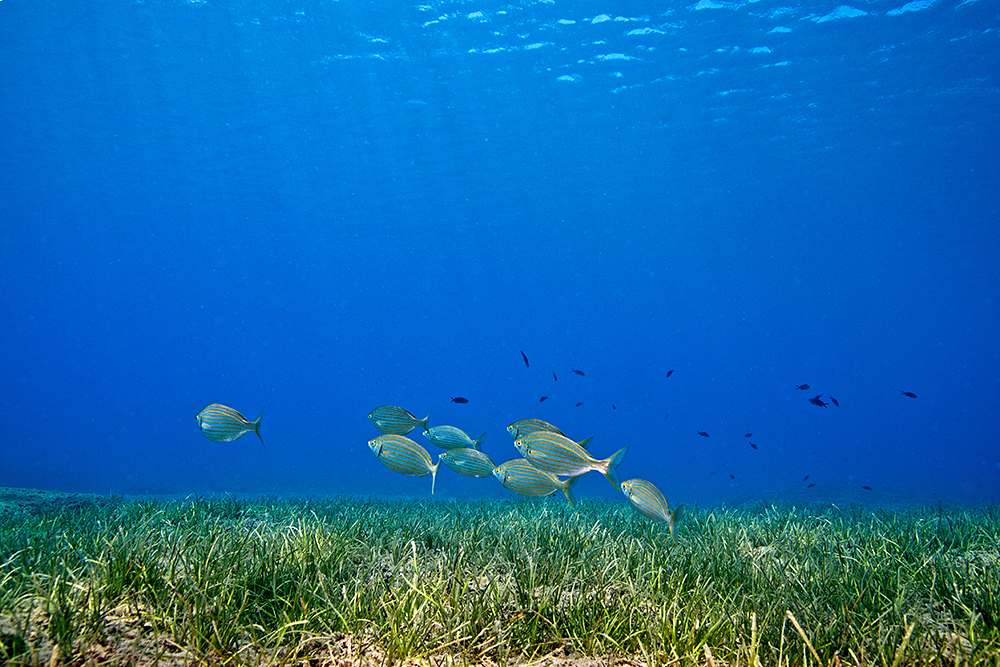
A new paper published in BioScience, “Measuring and Reporting on Seagrass as an Essential Ocean Variable for Science and Management”, proposes the first comprehensive, community-endorsed specification framework for measuring and reporting seagrass as a Biology and Ecosystems Essential Ocean Variable (BioEco EOV). The initiative, led by OBIS (the Ocean Biodiversity Information System) and GOOS (the Global Ocean Observing System), lead Dr. Lina Mtwana Nordlund (Associate Professor, Uppsala University) and co-lead Dr. Dimitris Poursanidis (Founder, Terrasolutions; MENA Oceans Network Domain Specialist) calls on seagrass communities worldwide to collect and share data in a unified format, turning fragmented local snapshots into a coherent global picture.
Despite seagrass meadows’ fundamental role in coastal ecosystems, the scientific record remains patchy and hard to compare. Data has been, and is being, collected using different methods, at different scales, for different local purposes, with little flowing into global biodiversity platforms. The new framework addresses this directly. It establishes three core variables: percentage cover, species composition, and areal extent, and proposes a tiered approach to observation, from high-resolution field surveys down to basic presence-or-absence records. The result is a system designed to work everywhere, regardless of scientific capacity, and to produce data that is FAIR: Findable, Accessible, Interoperable, and Reusable.
Seagrass Coverage & Conservation in MENA
Across the eastern Mediterranean, the Red Sea, and the Arabian Gulf, the MENA region hosts some of the most ecologically significant, and most vulnerable, seagrass ecosystems on Earth. The Mediterranean’s Posidonia oceanica, the sea’s only endemic seagrass species, covers an estimated 25,000–50,000 km² of coastal habitat. The Arabian Gulf, despite extreme salinity and temperature swings, holds around 6% of the world’s total seagrass area, spanning roughly 7,000 km², with 80% concentrated in Abu Dhabi alone, and supports the world’s second-largest dugong population. The Red Sea hosts at least twelve seagrass species. Yet, no complete mapping of the seagrass meadows in the Arabian Gulf and the Red Sea has been achieved.
These meadows are nursery grounds for commercially important fish, shrimp, and pearl oysters; formidable blue carbon stores; and coastal buffers that MENA communities have depended on for millennia.
In recognition of their importance, some of the world’s most consequential seagrass conservation work is happening here. In the Arabian Sea and Arabian Gulf, the Marawah Marine Biosphere Reserve in Abu Dhabi is a global stronghold for the region’s dugong population, with systematic surveys having mapped over 3,000 km² of seagrass since 2001. A significant stretch of Qatar’s western waters, specifically in the Gulf of Salwa, have been designated as a dedicated dugong and seagrass protected area, with active seagrass restoration and drone-based monitoring of the large dugong aggregations. At COP28 in Dubai, the CMS Office announced the 2030 Seagrass Breakthrough: a collective global conservation framework, with the UAE and Saudi Arabia as its first two national endorsers; and Abu Dhabi will host the 16th International Seagrass Biology Workshop in 2026.
Saudi Arabia’s National Center for Wildlife conducts systematic seagrass surveys on both its Red Sea and Arabian Gulf coasts. Red Sea Global has launched the first seagrass transplantation programme at Al Wajh Lagoon and AMAALA. Marsa Abu Dabab, home to one of the largest seagrass patches on the Egyptian coast, is actively monitored by rangers protecting resident dugongs and sea turtles from boat disturbance.
Tunisia, which holds more than a third of all Posidonia oceanica meadows in the Mediterranean, has integrated seagrass protection into at least twelve existing and planned marine protected areas, and participates in the regional SPA/RAC MedPosidonia mapping initiative alongside Algeria and Libya.
Why the OBIS–GOOS Framework Matters
The new framework arrives at a moment when the region has the conservation infrastructure, scientific expertise, and political momentum to scale its efforts, but not yet the data integration to match. The framework offers an opportunity to aggregate siloed data: its three-tier approach, designed to work from high-resolution field surveys down to basic presence-or-absence observations, means that data generated at every level can be standardised, published to OBIS, made to count toward national commitments under the Kunming-Montreal Global Biodiversity Framework, and underpin blue carbon finance. It also opens the door to rescuing legacy data: Abu Dhabi’s 25 year archive alone would constitute one of the most significant contributions to the global record. For citizen scientists and coastal communities across the region, the framework offers a pathway to turn public engagement into data-generating infrastructure.
As such, the MENA region is uniquely positioned to become a cornerstone of the global seagrass record. The framework creates the conditions for long‑term accountability, climate finance readiness, and a new era of regionally driven ocean stewardship.
Read the full paper : obis.org/2026/02/27/guidelines-for-seagrass-measuring-and-reporting
Find the current EOV Specification Sheet on Seagrass Cover and Composition here: https://goosocean.org/document/17513
