
Contributed by Yaprak Arda (Marine Programme Officer, IUCN Med)
Tunisia is entering a decisive phase in its marine conservation pathway. Through the “Tunisia Towards 30×30” initiative, the country is moving beyond commitment towards the implementation of the global 30×30 target, protecting 30% of land and sea by 2030. At a time when marine ecosystems across North Africa and the Mediterranean are under mounting pressure, Tunisia’s approach offers both urgency and optimism: a structured, science-based pathway to expand protection, strengthen governance, and deliver tangible benefits for people and nature.
A Strategic Moment for Action
Tunisia’s marine and coastal ecosystems are among the most valuable in the Mediterranean. They underpin fisheries, sustain local livelihoods, and provide natural buffers against climate impacts. Yet, despite their importance, less than 3% of Tunisia’s marine territory is currently protected, highlighting a critical gap between ecological value and conservation coverage.
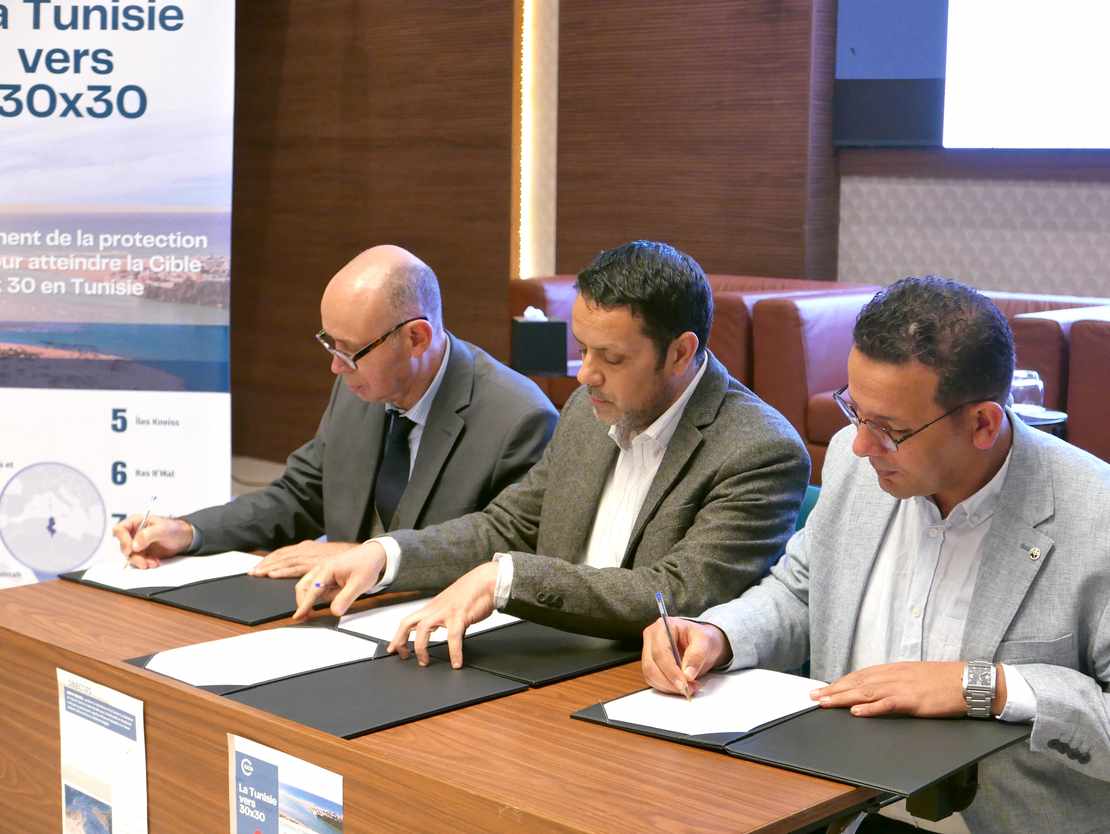
Tunisia Towards 30×30 responds directly to this challenge. The initiative aims to expand marine and coastal protected areas (MCPAs) to approximately 8.5% of national waters by 2029, covering over 3,000 km². This represents a major step toward the 30% target while laying the institutional and ecological foundations for further expansion. This initiative which is funded by Oceans 5 is coordinated by IUCN Centre for Mediterranean Cooperation in collaboration with UNEP-MAP SPA/RAC and WWF North Africa, under the auspices of the Ministry of Environment and the Agency for the Protection and Management of the Coast.
By applying global standards such as the IUCN Green List and using Key Biodiversity Area (KBA) methodologies, Tunisia is ensuring that new and existing protected areas are ecologically meaningful, well-managed, and socially inclusive. Maher Mahjoub, IUCN Med Director indicated “The Green List can be used to guide improved management at site level and as framework for protected area management at national level, integrating its principles and components into the design of management plans. The new Committee for the Green List in Tunisia with different government bodies can ensure coordinated and continuous support and enhance the alignment of protected area management plans with the Green List.”
From Sites to Systems: Building a Connected Network
At the heart of the initiative is the development of a coherent and representative network of MCPAs. The project targets seven key sites across Tunisia’s coastline, including:
- The Galite Archipelago
- Zembra and Zembretta National Park
- The Kuriat Islands
- The Kneiss Islands
- The Kerkennah North Islets
- Ras R’mel in Djerba
- The Boughrara Lagoon
These areas encompass critical habitats ensuring that conservation efforts capture the diversity of Tunisia’s marine environments.
Addressing Pressures Where They Matter Most
Tunisia’s 30×30 advancement comes at a time of intensifying anthropogenic pressures. Overfishing continues to strain marine resources and threaten small-scale fisheries. Coastal development is accelerating habitat degradation, particularly in sensitive areas such as lagoons and wetlands. Meanwhile, climate change is amplifying risks through warming waters, sea-level rise, and ecosystem shifts.
The initiative tackles these challenges through an integrated approach. Its technical pathway strengthens biodiversity data, closes knowledge gaps, and supports science-based planning. Its governance pathway empowers civil society and local communities to co-manage resources and adopt sustainable practices. And its institutional pathway works to streamline legal processes, enhance coordination, and build the capacity needed for long-term management.
This ensures that conservation is not only designated on paper but implemented effectively on the ground.
Delivering Benefits for Communities and Economies
A defining strength of Tunisia’s approach is its recognition that marine conservation and socio-economic development are deeply interconnected.
By strengthening MCPAs, the initiative is expected to:
- Enhance the long-term conservation of key habitats and species
- Improve climate resilience of coastal ecosystems
- Support sustainable fisheries and nature-based livelihoods
- Deliver tangible benefits for local communities and future generations
Equally significant is the emphasis on inclusive governance. By engaging local NGOs, fishers, and community groups, the project builds local ownership and ensures that conservation outcomes are both equitable and durable.
A Catalyst for Regional Momentum
Tunisia’s progress is unfolding within a broader wave of Mediterranean conservation ambition. Regional frameworks such as the Post-2020 SAPBIO and strategies for marine protected areas are creating alignment across countries, while partnerships among organizations are strengthening technical and financial support.
In this context, Tunisia Towards 30×30 stands out as a practical and replicable model for North Africa. Its structured approach offers valuable lessons for countries facing similar ecological and institutional challenges.
Moreover, the initiative’s integration with regional mechanisms, including emerging technical support platforms under the Convention on Biological Diversity, positions Tunisia as both a beneficiary and a contributor to Mediterranean-wide progress.
Looking Ahead
Tunisia Towards 30×30 is more than a national conservation effort, it is a signal of growing momentum across the Mediterranean. By aligning global ambition with local action, Tunisia is demonstrating how countries can move decisively from targets to transformation.
As pressures on marine ecosystems intensify, this kind of leadership is not only timely, but also essential.
