
International Day of Combating Sand and Dust Storms – 12 July
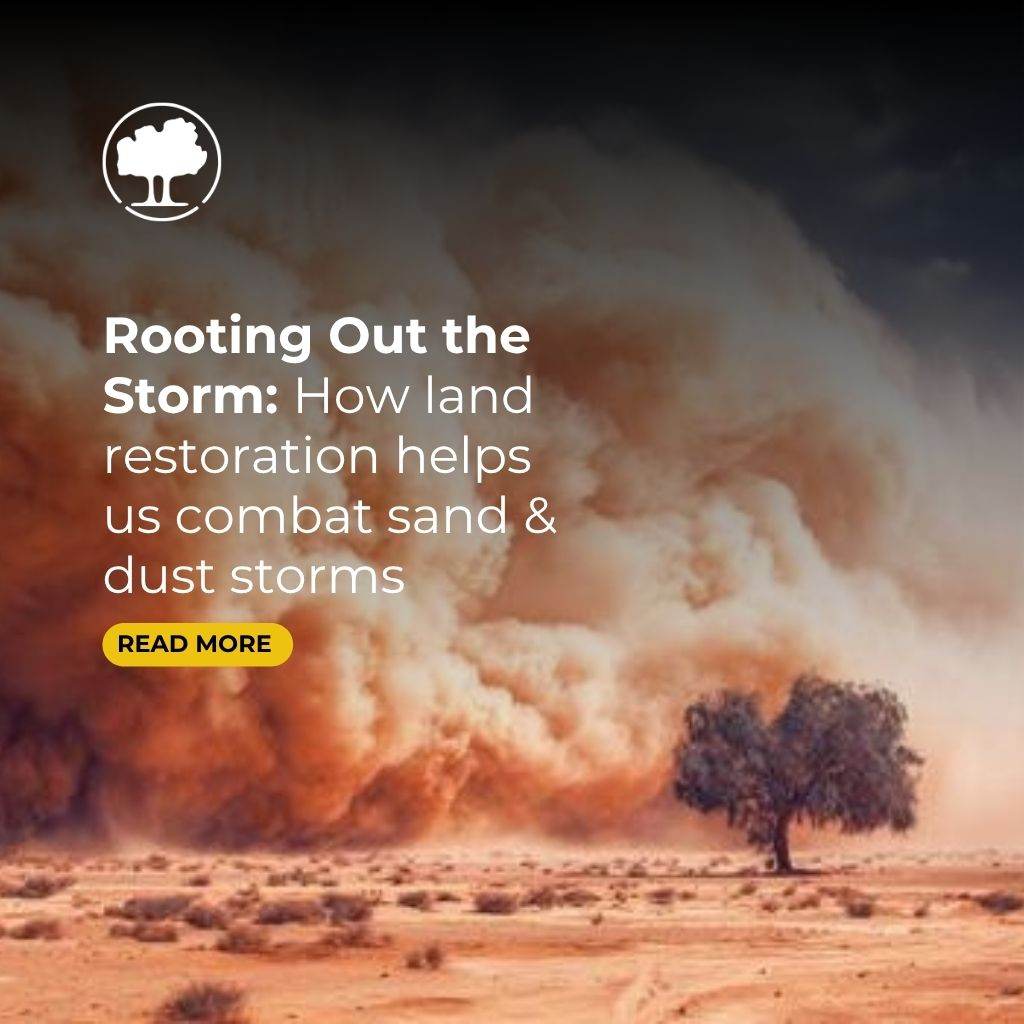
Every year on 12 July, the world pauses to reckon with one of nature’s most dramatic and destructive phenomena: sand and dust storms. Towering walls of orange haze that swallow cities whole, turn day into night, and travel thousands of kilometres across oceans and continents. This year’s observance carries forward the theme “Sand and Dust Storms: Working Across Agendas for Resilience and Sustainability,” a call for countries, sectors, and communities to stop treating this as an isolated environmental issue and start tackling it as the cross-cutting crisis it truly is, one intertwined with food security, health, water, and land.
Nowhere is this “working across agendas” spirit more visible than right here in the UAE, where Goumbook, the region’s leading social enterprise for sustainability and climate action, has spent over a decade proving that land restoration isn’t a distant policy goal, it’s dirt-under-your-fingernails, tree-by-tree, farm-by-farm work. Through three of its flagship programmes – Give A Ghaf, Mangroves Matter, and the MENAT Regenerative Agriculture Venture Programme. Goumbook is tackling the very drivers of desertification and dust: bare soil, degraded coastlines, and unsustainable farmland.
The Scale of the Problem
- An estimated 2 billion tonnes of dust are lifted into the atmosphere every year.
- Sand and dust storms now affect 151 countries worldwide, disrupting agriculture, transportation, energy systems, and human health.
- At least 25% of global dust emissions come from human activities not natural desert processes meaning land degradation and unsustainable land use are directly fueling the storms.
- Across the MENAT region (Middle East, North Africa & Türkiye), irrigated farming consumes 85% of renewable water resources, while 40–70% of agricultural land is already degraded, a combination that leaves soil exposed and primed to blow away.
- Globally, 36 football fields of forest disappear every minute, contributing 12–17% of annual greenhouse gas emissions.
Give A Ghaf: Why Desert Roots Are the First Line of Defence
Sand and dust storms take hold where soil has nothing left to bind it. That’s exactly why Goumbook’s Give A Ghaf programme centres on the Ghaf, the UAE’s official national tree, declared in 2008, and arguably the single best-adapted species for holding desert ground in place.
- The Ghaf’s roots can plunge as deep as 30 metres underground in search of moisture, giving it an anchoring power in loose sand that few other species can match precisely the kind of root structure that stabilises dunes and resists wind erosion.
- It can live for up to 120 years, meaning a single tree provides continuous, decades-long soil stabilisation rather than a short-term fix.
- As a drought-tolerant, evergreen species, the Ghaf survives extreme heat and near-zero rainfall without irrigation, a critical trait in a region where water scarcity limits what restoration efforts are even viable.
- Its presence has traditionally signalled underground water to desert communities, and ecologically it enriches surrounding soil and shelters other native species, making it a keystone tree for rebuilding degraded drylands rather than just adding greenery.
This is why tree planting matters as an SDS solution: it isn’t decorative afforestation, it’s targeted, native-species root infrastructure built specifically to hold sand where wind would otherwise pick it up.
The science behind it: Research on shelterbelts, linear tree plantings functioning much like Ghaf stands shows they can cut wind speed at ground level by 30–80%, with corresponding reductions in soil loss often exceeding 50%, and in some studies as high as 80%. A study on farmland bordering the Beijing–Tianjin–Hebei dust corridor found that windbreak-protected fields had 20% lower dust emissions and 20% less soil loss than unprotected farmland, with wind speed reduced by roughly 27–30% near the surface. Crucially, research shows shelterbelts don’t work by filtering dust out of the air after the fact — they work by keeping wind below the threshold friction velocity needed to lift soil particles in the first place, meaning prevention happens at ground level before dust ever becomes airborne. Studies also show that a moderately porous barrier (around 40–60% porosity — allowing some wind through rather than blocking it completely) outperforms a solid wall, since it slows wind gradually rather than creating the turbulence that can lift dust back up on the leeward side.
Mangroves Matter: Why Coastal Roots Matter Just as Much as Desert Ones
Dust and sand don’t respect the line between desert and coastline, degraded coastal land can be just as significant a source of wind-blown sediment, and coastal ecosystems play an outsized role in overall land and climate resilience. That’s the logic behind Mangroves Matter, part of Goumbook’s Trees Matter restoration work.
- Mangrove soil sequesters carbon at a rate of roughly 0.5 tonnes per hectare per year — equivalent to one tonne of carbon locked away for every 5,000 mangrove trees — making mangroves one of the most carbon-efficient restoration tools available, directly relevant given that climate change is itself a driver of intensifying sand and dust storms.
- Their dense root systems bind loose coastal soil and sediment, acting as a natural barrier against erosion, storm surge, and shoreline destabilisation, the coastal equivalent of what Ghaf roots do inland.
- Mangroves filter pollutants from water and support fisheries and biodiversity, meaning restoration delivers food security and water-quality benefits alongside erosion control.
- The UAE’s national target to plant 100 million mangroves by 2030, and the global Mangrove Breakthrough movement’s goal to restore 15 million hectares worldwide by 2030, reflect a growing scientific consensus that coastal restoration is inseparable from broader land and climate resilience strategies.
Restoring mangroves isn’t a side project to desert restoration, it’s the same fight against destabilised land, waged at the water’s edge.
The science behind it: A healthy mangrove forest can reduce the force of an incoming wave by over 60% within just the first 100 metres of forest edge, and coastal mangrove belts 500 metres or more wide can dissipate roughly 75% of incoming wave energy. That wave dissipation isn’t incidental to erosion control, it’s the mechanism: by slowing water movement, mangrove root networks encourage suspended sediment to settle and accumulate rather than wash away, in some studies reducing shoreline erosion rates by 3 to 15 times compared to unvegetated coastline. This continuous sediment trapping actually raises the coastal soil surface over time, which is exactly what allows mangrove coastlines to keep pace with rising seas rather than be submerged by them — turning root systems into a slow, self-reinforcing land-building process rather than a one-time fix.
MENAT Regenerative Agriculture: Fixing the Problem at Its Source
Tree planting restores land that has already degraded. Regenerative agriculture aims to stop degradation from happening in the first place, which is why it sits at the centre of Goumbook’s approach to tackling sand and dust storms.
- Across the MENAT region, irrigated farming consumes 85% of renewable water resources, while 40–70% of agricultural land is already degraded, precisely the conditions that turn productive land into a dust source once vegetation cover is lost.
- Regenerative practices, soil-rebuilding fertilisers, reduced tillage, drought-resilient and salt-tolerant crop varieties, reduced chemical inputs, directly rebuild the organic matter and structure that keep soil intact and moisture-retentive, reducing how easily wind can lift it.
- Because these practices also sequester carbon, regenerative agriculture tackles climate change and desertification simultaneously, addressing both a driver and a consequence of sand and dust storms in one intervention.
- By focusing on soil health, water efficiency, and climate resilience together, the programme treats farmland not as a passive victim of SDS but as a landscape that, managed correctly, can actively resist becoming a dust source.
This is the piece that closes the loop: trees and mangroves restore what’s already degraded, while regenerative agriculture protects the vast stretches of working farmland that would otherwise be next.
The science behind it: Wind erosion begins once wind speed at the soil surface crosses a “threshold friction velocity”, the point at which loose particles lift off the ground. Research shows this threshold is directly tied to soil organic matter, moisture, and surface roughness, exactly the properties regenerative practices are designed to build. Cover crops and crop residue left on the surface slow wind speed at ground level and physically shield soil particles from direct wind contact, while also protecting soil aggregates from breaking down under raindrop impact, aggregates which themselves need to be large and stable enough to resist being lifted by wind in the first place. Even without full canopy cover, surface residue and root biomass increase surface roughness enough to meaningfully raise the wind speed needed to trigger erosion, meaning regenerative soil management doesn’t just improve fertility, it changes the physics of whether soil becomes airborne dust at all.
What This Means for All of Us
You don’t need to live in a dust-prone region to have a stake in this. Dust clouds cross oceans, degraded rangelands affect global food supply chains, and the carbon locked in or released from soil affects the entire planet’s climate trajectory. Getting involved is often as simple as it sounds: plant a Ghaf tree for corporate team day, join a mangrove planting event, or support the researchers building the next generation of regenerative farming solutions.
The wind will always blow. But healthy, well-rooted land, desert, coast, and farm alike, gives it far less to carry.
Sources: United Nations (un.org), UN Food and Agriculture Organization (FAO), UN Convention to Combat Desertification (UNCCD), Goumbook (goumbook.com), Khaleej Times, ESG Mena, and peer-reviewed research published in MDPI Forests, ScienceDirect (Aeolian Research, Agricultural and Forest Meteorology), Agrosystems Geosciences & Environment, and Communications Earth & Environment.
