
Source: FAO GCC Food and Agriculture Policy Flash, April 2026 – drawing on analysis by FAO RNE’s Strategy and Policy Unit
The escalation of conflict in the Middle East in 2026 has brought into sharper focus a structural reality that regional food security discussions have long acknowledged but rarely quantified with precision: the overwhelming dependence of GCC countries on a single maritime corridor for the vast majority of their food supply. A recent FAO policy flash, drawing on granular bilateral trade analysis by FAO RNE’s Strategy and Policy Unit, now makes that exposure concrete, country by country, food group by food group, and in monetary terms.
The findings are significant not because they reveal something unknown, but because they establish the scale and breadth of a vulnerability that, under conditions of sustained disruption, could rapidly exceed the buffering capacity of existing reserves.
A region dependent on maritime trade for its food supply
Across the GCC, between 70 and 90 percent of food supply is sourced from international markets. This is not a temporary condition but a structural feature of regional economies shaped by water scarcity, limited arable land, and climatic constraints that make large-scale domestic agricultural production exceptionally difficult. Historically, this dependence has been managed through open trade relationships, strong purchasing power, and the maintenance of strategic reserves, mechanisms that have generally allowed countries to secure supplies even during periods of global market volatility.
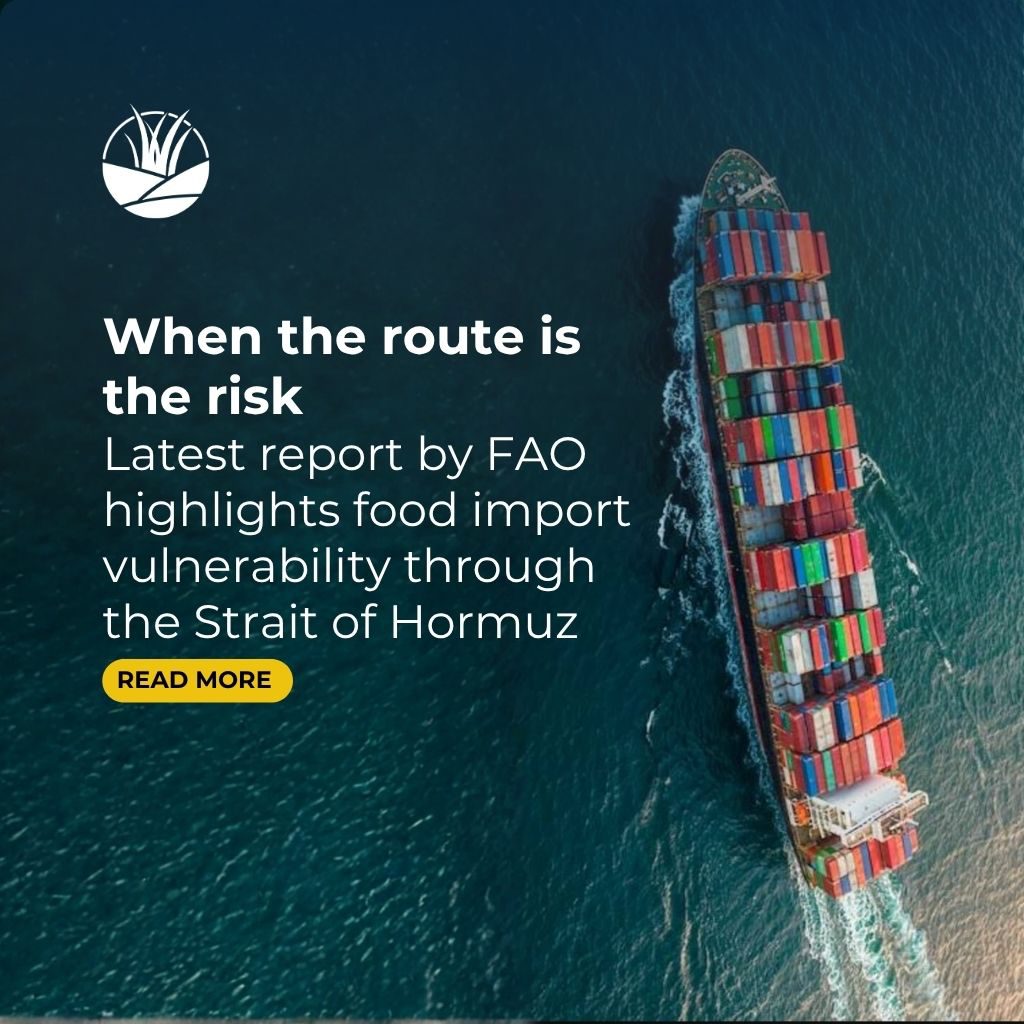
What the current analysis makes clear, however, is that virtually all of these imports flow through a single maritime chokepoint: the Strait of Hormuz. With tanker traffic through the Strait declining by more than 90 percent within days of the 2026 escalation, the principal route through which food imports enter the region came under severe strain, raising questions about supply continuity that strategic reserves alone cannot fully answer.
GCC countries import close to 100 million tonnes of food annually. Even short disruptions introduce logistical complexity; extended ones risk supply bottlenecks across multiple commodity categories simultaneously.
The numbers: country-level import dependency and chokepoint exposure
FAO RNE’s bilateral trade matrix provides a detailed assessment of how food import dependence translates into chokepoint exposure. The results show that vulnerability is both high and highly concentrated.
Table 1 — Overall Import Dependency and Chokepoint Vulnerability
| Country / Subregion | Total Food Supply (kcal/capita/day) | % Imported | Food Spend (USD/capita/yr) | % Chokepoint-Exposed |
| Bahrain | 3,423 | 87% | $643 | 100% |
| Kuwait | 3,136 | 82% | $647 | 100% |
| Oman | 2,981 | 72% | $515 | 100% |
| Qatar | 3,251 | 81% | $711 | 100% |
| Saudi Arabia | 3,660 | 74% | $416 | 59% |
| UAE | 3,125 | 89% | $1,123 | 100% |
| GCC Subregion | 3,433 | 78% | $594 | 84% |
Source: FAO RNE Strategy and Policy Unit, April 2026
The figures are striking in their consistency. Bahrain, Kuwait, Qatar, Oman, and the UAE each record full chokepoint exposure, meaning that 100 percent of their imported food supply transits through Hormuz. The UAE combines the highest import dependency in the subregion, at 89 percent, with full exposure, reflecting the scale and centralisation of its food import system. Saudi Arabia presents a more differentiated picture: its access to Red Sea ports reduces chokepoint exposure to 59 percent, but even here, 74 percent of total food supply is import-dependent, and those alternative routes carry their own security risks and cannot fully absorb the volume typically handled through Hormuz.
In monetary terms, per capita food imports exposed to chokepoints exceed USD 1,100 in the UAE, reach approximately USD 700 in Qatar, and surpass USD 600 in both Kuwait and Bahrain. These figures reflect not only the volume of imports but also the reliance on higher-value food products, which may be more sensitive to disruptions in logistics and pricing.
Beyond cereals: exposure runs across the full dietary basket
Perhaps the most consequential finding of the analysis is that import dependence and chokepoint exposure are not confined to cereals or staple commodities. They extend across the full dietary basket, with comparable patterns observed in oils, animal products, sugar, and pulses.
Table 2 — Import Dependency and Chokepoint Vulnerability by Food Group (Part A: Cereals, Animal Foods, Oils/Fats/Nuts, Sugar)
| Country / Subregion | Cereals % Imported | Cereals % Choke-Exposed | Animal Foods % Imported | Animal Foods % Choke-Exposed | Oils/Fats/Nuts % Imported | Oils/Fats/Nuts % Choke-Exposed | Sugar % Imported | Sugar % Choke-Exposed |
| Bahrain | 96% | 96% | 81% | 81% | 100% | 100% | 100% | 100% |
| Kuwait | 99% | 99% | 73% | 73% | 98% | 98% | 74% | 74% |
| Oman | 100% | 100% | 74% | 74% | 75% | 75% | 100% | 100% |
| Qatar | 89% | 89% | 80% | 80% | 93% | 93% | 85% | 85% |
| Saudi Arabia | 94% | 39% | 47% | 20% | 84% | 59% | 100% | 98% |
| UAE | 96% | 96% | 92% | 92% | 77% | 77% | 100% | 100% |
| GCC Subregion | 95% | 59% | 63% | 63% | 84% | 70% | 97% | 96% |
Table 2 — Import Dependency and Chokepoint Vulnerability by Food Group (Part B: Pulses, Vegetables, Fruits)
| Country / Subregion | Pulses % Imported | Pulses % Choke-Exposed | Vegetables % Imported | Vegetables % Choke-Exposed | Fruits % Imported | Fruits % Choke-Exposed |
| Bahrain | 100% | 100% | 94% | 94% | 65% | 65% |
| Kuwait | 100% | 100% | 76% | 76% | 36% | 36% |
| Oman | 100% | 100% | 38% | 38% | 20% | 20% |
| Qatar | 95% | 95% | 83% | 83% | 59% | 59% |
| Saudi Arabia | 94% | 60% | 43% | 10% | 14% | 5% |
| UAE | 100% | 100% | 97% | 97% | 77% | 77% |
| GCC Subregion | 97% | 97% | 56% | 40% | 23% | 16% |
Source: FAO RNE Strategy and Policy Unit, April 2026
At the subregional level, cereals show import dependency of 95 percent, with 59 percent exposed to Hormuz. Oils, fats, and nuts reach 84 percent import dependency, with 70 percent of supply routed through the same corridor. Sugar reaches 97 percent import dependence, with 96 percent chokepoint exposure. Pulses show near-total import dependency at 97 percent, and animal source foods, often assumed to be more diversified, still record 63 percent import dependency, with the same share routed through Hormuz.
This breadth matters because it determines how disruptions would materialise in practice. A supply shock concentrated in cereals would affect a single commodity group with relatively established reserve systems. A shock running across cereals, oils, animal products, and sugar simultaneously would engage supply chains that differ significantly in their storage requirements, perishability, and potential for substitution, making the policy response considerably more complex.
The limits of strategic reserves
GCC governments maintain strategic reserves as a core component of their food security architecture, and these have historically provided effective short-term buffers against global price volatility. The FAO analysis does not directly measure reserve levels, but its findings highlight a gap in coverage that existing reserve systems were not designed to close.
While cereals account for a significant share of caloric intake and benefit from established reserve mechanisms in several GCC countries, other food groups with comparable import dependence and chokepoint exposure, particularly oils and animal source foods, do not appear to be buffered to the same extent. These categories tend to be more difficult to store at scale, more tightly linked to continuous import flows, and more sensitive to disruptions in refrigerated or specialised logistics chains.
Strategic reserves provide temporary coverage typically measured in months. Their gradual depletion under conditions of sustained disruption would coincide with rising import costs driven by longer alternative shipping routes, higher insurance premiums, and tightening global supply conditions, a compounding dynamic that underscores the limits of stockpiling as a standalone response.
The structural imperative: building local production capacity
The analysis does not prescribe a policy response, but its implications are clear. Reducing food import vulnerability in the GCC requires more than managing the logistics of existing supply chains. It calls for a sustained and strategic expansion of domestic food production capacity, building the ability to supply essential food products locally, across a range of commodity categories, and at sufficient scale to reduce structural dependence on a single maritime corridor.
This is not a straightforward task given the region’s resource constraints, but it is one that several GCC governments have already begun to pursue through targeted investments in controlled environment agriculture, agri-technology, aquaculture, and integrated food production systems. The current situation makes the urgency of these efforts more tangible, and the FAO data provides the evidential foundation to justify their prioritisation at the highest levels of food security policy.
For the region’s food systems, the route has long been the risk. The question now is how rapidly production capacity can be built to reduce the exposure that this analysis has, for the first time, quantified in full.
This blog draws on the FAO GCC Food and Agriculture Policy Flash (April 2026) and FAO RNE’s Global Agrifood Implications of the 2026 Conflict in the Middle East.
