
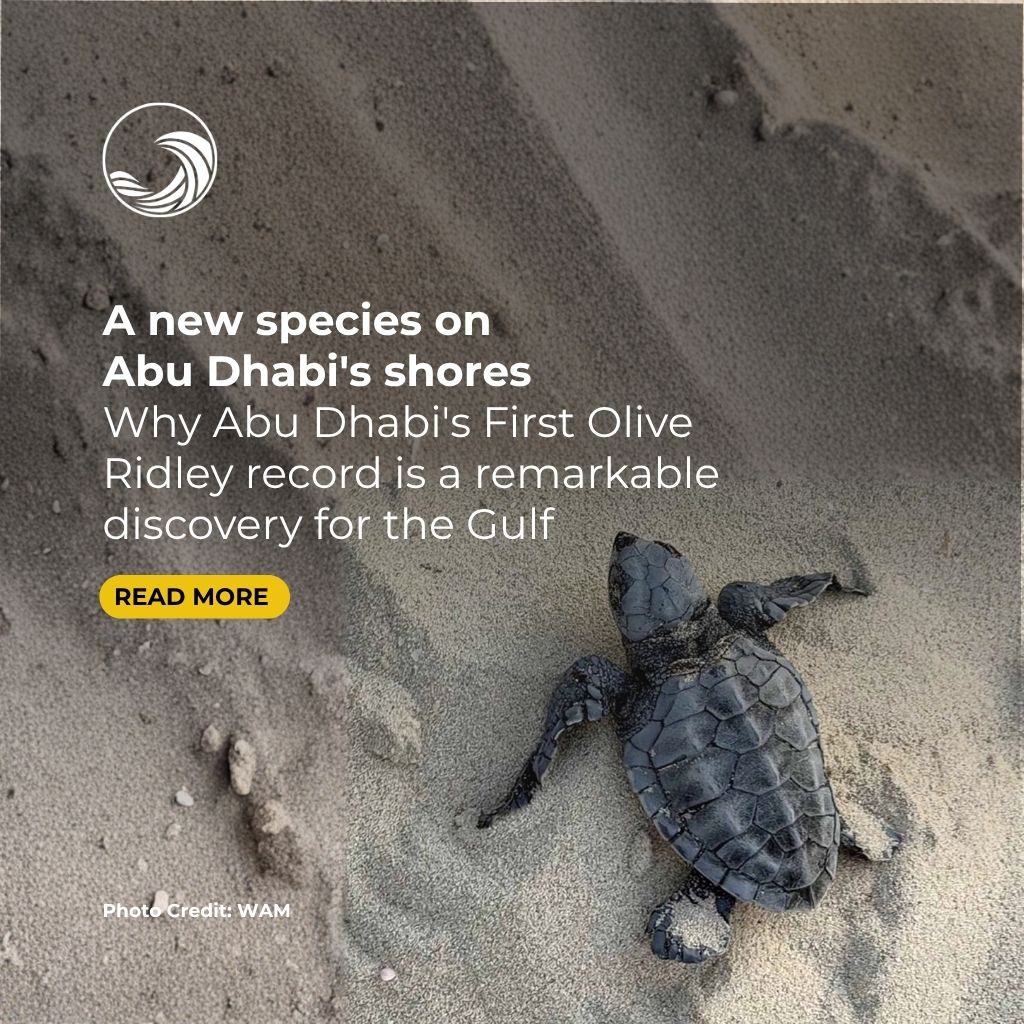
In August 2026, the Environment Agency – Abu Dhabi (EAD) confirmed the first recorded nesting of an olive ridley turtle (Lepidochelys olivacea) in the emirate, on Saadiyat Island. For twenty-five years, Abu Dhabi’s marine turtle monitoring programme had documented one dominant nesting species along its coastline and offshore islands: the hawksbill. The first green turtle nest appeared in 2023. The olive ridley – never been recorded nesting in the emirate.
The credit runs from field to laboratory, highlighting a robust and participatory monitoring system built over two and a half decades. Volunteers with the Environment Agency Abu Dhabi’s (EAD) Saadiyat Turtle Patrol tracked the nest via solar camera through its full incubation window, intensifying their watch as the hatch date neared. With no prior record for the species in the Emirate, EAD did not rely on visual identification alone. Working with Khalifa University, the agency ran DNA barcoding against international reference libraries, returning a 99 percent match to Lepidochelys olivacea. Of the 109 eggs laid on 29 March, 40 hatchlings made it to the sea on 25 May – marking a hatching success rate of roughly 37 percent that. For a first nesting attempt at the outer edge of the species’ range, this is a sound result – modest but sufficient to complete the reproductive cycle and establish a baseline for what comes next.
Comparative regional context: Distributional significance relative to Masirah Island, Oman
The regional context sharpens the significance. The only substantial olive ridley nesting population in the Arabian Peninsula is on Masirah Island, off the coast of Oman, where the species nests alongside hawksbills on the same stretches of beach between February and May, an overlap rarely seen anywhere else in the world, and one of the few features that makes Masirah’s turtle assemblage scientifically distinctive.
Even there, the species remains to be further studied, relative to Masirah’s loggerhead population, which is one of the largest in the world. A confirmed olive ridley nest roughly 700 kilometres away, inside the Arabian Gulf rather than the Arabian Sea, is therefore not a marginal data point, set against that single established stronghold. It opens a genuine question for regional science: is this an isolated vagrant event, or an early signal of a nesting range extending northward and westward into Gulf waters that have historically sat outside it. A distinction confirmed nesting in subsequent seasons would be required to resolve.
Watching this indicator species closely
Olive ridleys carry that designation for a reason – their presence, or absence, says something about the wider health of the waters they inhabit. As mesopredators feeding on jellyfish, crabs, shrimp and molluscs, they exert a stabilising effect on coral reef and seagrass food webs, and their nesting activity cycles marine-derived nutrients into coastal vegetation and shoreline structure. Listed as Vulnerable on the IUCN Red List and nesting at few locations globally, a confirmed nest anywhere – particularly in a body of water as thermally stressed and rapidly developed as the Gulf – carries disproportionate conservation weight.
Strengthening monitoring capacity and infrastructure
This finding sits on top of one of the more substantial marine turtle monitoring records in the region. Abu Dhabi’s waters are now confirmed home to four of the world’s seven turtle species – hawksbill, green, loggerhead, and now olive ridley – with an aerial survey putting the emirate’s turtle population at roughly 8,000 individuals across at least 17 known nesting sites. That this single, unexpected nest was caught, tracked and rigorously verified is itself a credit to that long-running programme, and a reminder of what sustained investment in marine science makes possible.
Paving the way forward
For ocean governance across the MENA region, this record builds a strong case for closer regional cooperation on marine turtle tracking and data-sharing, connecting nesting grounds from Masirah to Saadiyat and across the wider MENA coastline – to settle whether this is range expansion, a climate-linked shift, or simple chance. It is a reminder that species distribution across the region’s seas is not static, and that Gulf and Arabian Sea turtle populations may be more connected or more mobile under changing conditions.
[Source: Environment Agency – Abu Dhabi, via Abu Dhabi Media Office, 20 August 2026]
