
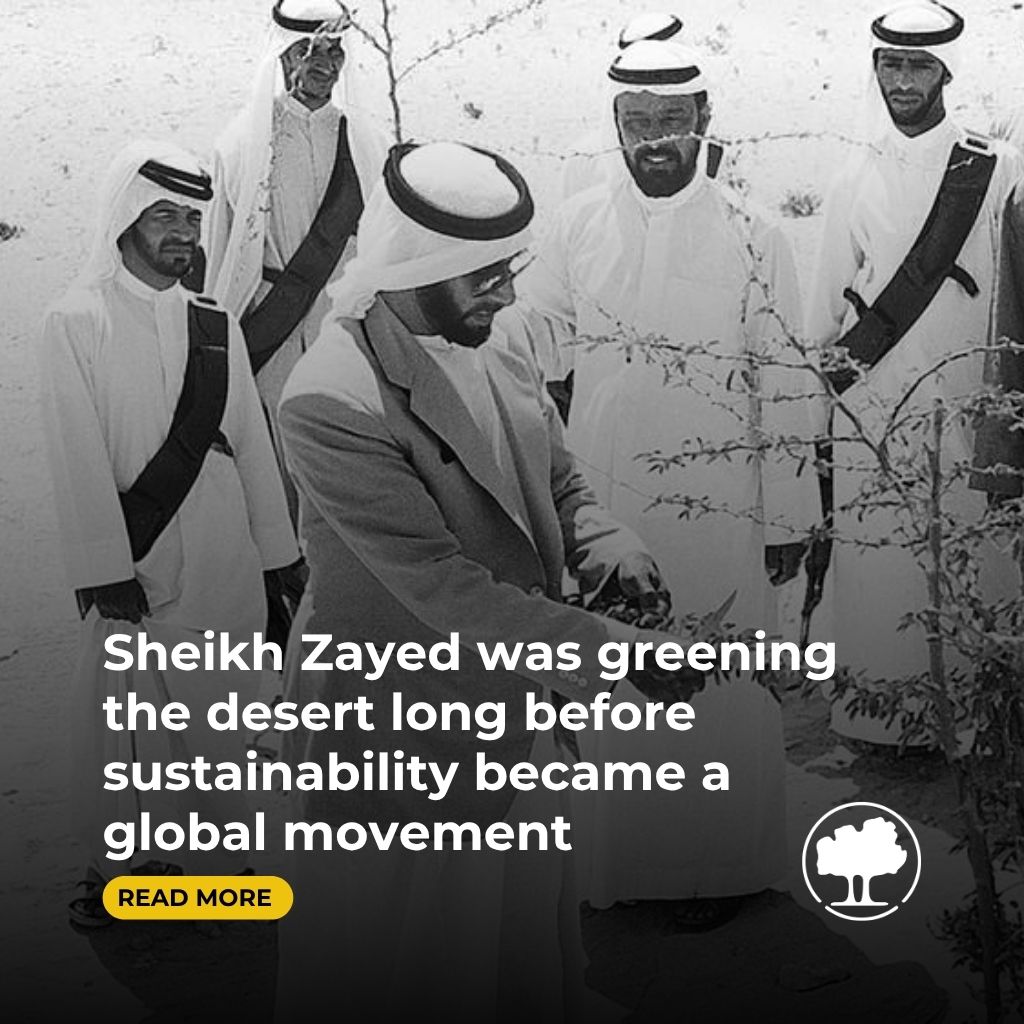
Long before the UAE became known for its green cities and ambitious environmental initiatives, the late Sheikh Zayed bin Sultan Al Nahyan, the Founding Father of the UAE, had a remarkable vision: to transform the desert into a greener, more resilient landscape.
His approach was bold for its time and deeply rooted in an understanding of the UAE’s environment.
Millions of trees for a greener UAE
In the 1980s, Sheikh Zayed directed large-scale forest planting across the UAE, including native species such as the Ghaf, Sidr and Samar. Contemporary accounts recorded that these forests eventually numbered more than 5 million trees. For Sheikh Zayed, planting trees was about much more than creating beautiful landscapes. Trees were part of the fight against desertification, helping to stabilise sand, create green belts and protect roads and communities from drifting sands
A vision for the Abu Dhabi–Al Ain landscape
One of the most remarkable examples was the transformation along the Abu Dhabi–Al Ain road. What began as a bold tree-planting vision helped transform the surrounding desert landscape, using species selected for their ability to withstand the UAE’s harsh conditions.
That vision became particularly visible in Al Ain, where decades of greening transformed the landscape. Satellite research shows that vegetation cover increased by an extraordinary 1,883% between 1972 and 2021, a transformation rooted in Sheikh Zayed’s determination to green the desert.
And at the heart of this legacy is a tree that has always belonged here: the Ghaf.
Resilient. Drought-tolerant. Deeply rooted in the UAE’s landscape, culture and heritage.
Sheikh Zayed understood that protecting nature was not separate from building the nation, it was part of building the nation.
In Al Ain, Sheikh Zayed’s connection with the Ghaf was deeply personal.
Historical accounts tell us that British explorer Wilfred Thesiger met with Sheikh Zayed under the shade of a venerable Ghaf tree in front of Qasr Al Muwaiji. The tree itself served as Sheikh Zayed’s majlis, a place for conversation, hospitality and connection.
An account from one of the agricultural officials who worked with him describes Sheikh Zayed directing tree planting from the early 1970s and emphasising the importance of conserving water.
A particularly interesting example is the tree-planting programme along roads, where Ghaf and other drought-tolerant trees were used to create green belts and help address sand movement and desertification.
The Ghaf was not simply a tree in the landscape. It was part of life.
And Sheikh Zayed understood its importance. He gave particular attention to the protection of the Ghaf and issued instructions to prevent the tree from being cut down.
But his environmental vision went far beyond protecting individual trees. Today, that vision continues. The Ghaf was later officially declared the UAE’s national tree in 2008, reflecting its cultural and ecological importance.
And perhaps his own words capture his ambition best:
“They used to say that agriculture has no future in the UAE, but with God’s blessing and our determination, we have succeeded in transforming this desert into a green land.”
— Sheikh Zayed bin Sultan Al Nahyan
Through Goumbook’s Give A Ghaf, inline with our new tagline Nature & Heritage, we are helping to continue carrying this legacy forward by spreading awareness and encouraging communities, schools and organisations to plant, protect and celebrate the UAE’s National Tree, while keeping alive the deep connection between the Ghaf, our natural environment and our heritage.
Did you know about Sheikh Zayed’s vision to green the desert?
