
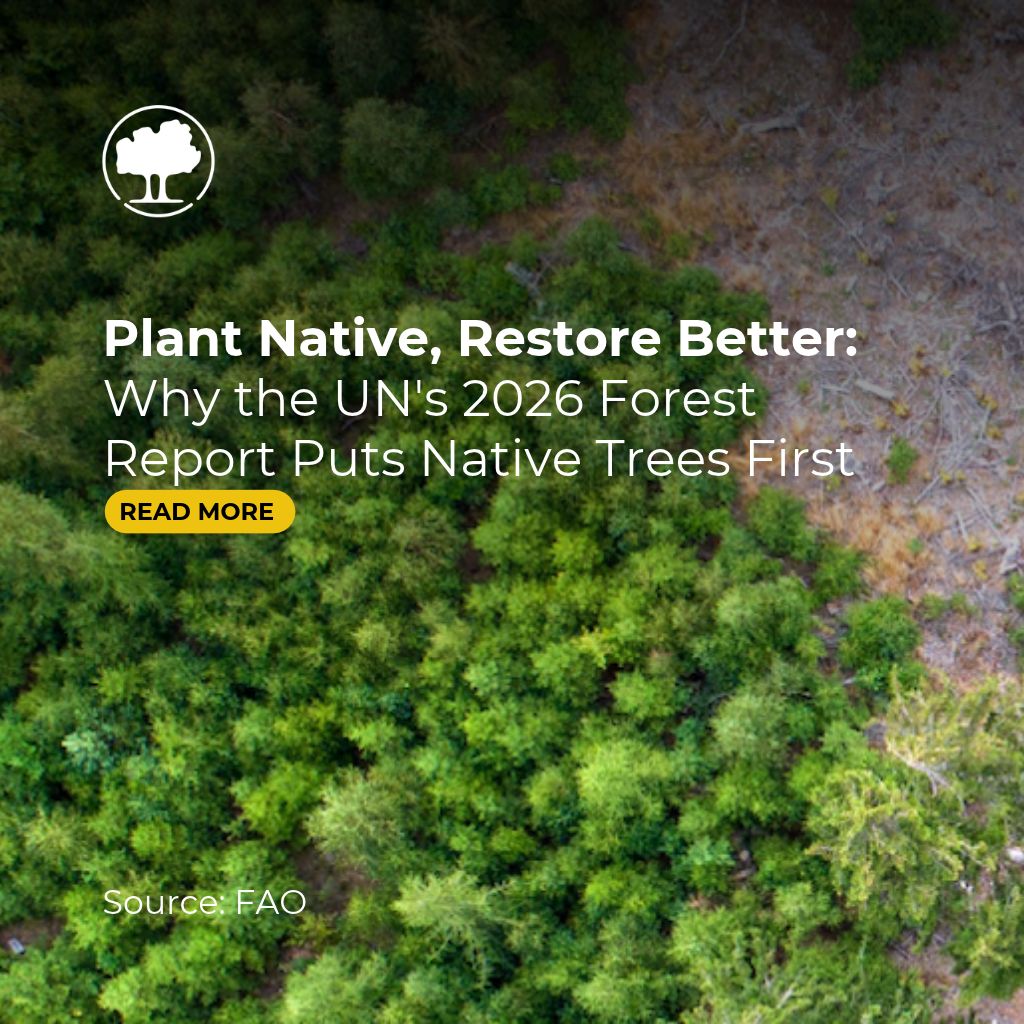
The Food and Agriculture Organization of the United Nations (FAO) has published The State
of the World’s Forests 2026. Its message is clear: the world must restore degraded land faster, and it must do it better. Planting the right native trees, in the right places, is where that work begins.
A planet that needs repair
Forests still cover 4.14 billion hectares, about 32 percent of the Earth’s land. But the losses are large. FAO estimates that 489 million hectares of forest have been lost to deforestation since 1990. Degradation is growing too. The share of degraded land rose from about 11 percent in 2015 to 15 percent in 2019. That is more than 1.56 billion hectares, including 460 million hectares of forest land. The report’s answer is forest and landscape restoration. This means more than planting trees. It means rebuilding whole landscapes so they work for nature and for the people who depend on them.
The case for acting now
The economics are strong. Under the right conditions, FAO says restoration can return up to USD 30 for every dollar invested. Doing nothing costs far more: an estimated USD 878 billion to USD 6.3 trillion a year in losses. Yet progress is behind schedule. Countries report almost 44 million hectares of forest under restoration in FAO’s latest global assessment. The global biodiversity target, restoring 30 percent of degraded ecosystems by 2030, means about 469 million hectares. Reaching it would require about 65.9 million more hectares under restoration every year from 2027.
Why native species matter
The report is clear that restoration outcomes depend on the quality, diversity and suitability of the species planted. It calls for species diversity and careful selection, especially of native species. Native trees have evolved for local soil, heat and rainfall. In the UAE, species such as the Ghaf, Sidr, Samr and Arak can survive long dry spells once established. They support local insects, birds and mammals that non-native trees cannot. Genetic origin matters as well. FAO notes that trees of the same species can perform very differently depending on where their seed came from. Locally collected seed gives trees a better chance against local pests, heat and a changing climate. That is why the Give A Ghaf programme uses seeds and pods collected from the wild locally, which is harvested every year during the summer.
Seven reasons to plant with purpose
Native trees serve different goals. Each one benefits from the report’s call for planting that fits the place.
- Conservation. Planting native trees in reserves and degraded habitats helps rebuild ecosystems and protect biodiversity. The report notes that biodiversity is not only an outcome of restoration but also what keeps restored ecosystems stable.
- Landscaping. Native trees in parks, schools, campuses and gardens provide shade
and greenery with less water than many non-native/imported species. They also bring
native wildlife back into towns and cities. - Afforestation. Planting new tree cover can stabilise sand and soil, provide shelter and
store carbon. The report warns that past efforts sometimes valued quantity over
quality, with limited biodiversity gains. Native, diverse and well-sited planting avoids
that trap. Four pathways to lasting results FAO identifies four pathways that make
restoration succeed at scale. Give A Ghaf brings each one into its planting work. - People. Restoration lasts longest when communities act as stewards of their
landscapes. Since 2011, Give A Ghaf has brought schools, families and companies
together to plant seeds/trees and care for seedlings. - Land. The report notes that landscape restoration depends on how each individual
plot of land is managed. That is why we partner with private landowners, from farms
to different institutions, to plant native trees on their land. Every tree adds greenery
and shade, and together these plantings create habitat that links up with nearby green
spaces, boosting biodiversity across the wider landscape. - Finance and business. FAO says restoration finance must roughly quadruple, from
USD 64 billion a year in 2022 to USD 296 billion a year by 2030. Corporate planting
days and tree sponsorships let businesses invest directly in native trees. - Policy coherence. Restoration works best when it builds on national strategies.
Native tree planting continues the vision of the late Sheikh Zayed bin Sultan Al
Nahyan, who began greening the desert in the early 1970s.
Quality over quantity
One of the report’s strongest messages is that counting hectares is not enough. What matters is whether ecosystems recover and whether livelihoods improve. FAO calls for restoration that follows standards of practice and is monitored over time. For us, that means focusing on trees that survive, not just seeds that are planted. A native tree that takes root in a schoolyard or a nature reserve is a long-term investment in shade, soil and biodiversity.
Lessons from the region
The report features 18 case studies of successful restoration, several from drylands like ours. In Jordan and Saudi Arabia, people and land lead restoration together. In Kenya, a low-cost “half-moon” technique rebuilds soil moisture on grazing land. Across the Sahel, the Great Green Wall links restoration to livelihoods and stability. The lesson is the same everywhere. Restoration works when native species, local knowledge and engaged communities come together.
Plant with us
The report calls the years to 2030 a narrow window for action. You can be part of it.
- Individuals and families: plant a native tree seed and become its guardian.
- Schools: join a hands-on planting session that brings local ecosystems into the classroom.
- Companies and landowners: organise a team planting day, sponsor native trees or green your grounds as part of your sustainability programme.
Contact us to get involved with the Give A Ghaf Nature and Heritage Programme.
Read the report: The State of the World’s Forests 2026 (full report) · In Brief summary
Source: FAO. 2026. In Brief to The State of the World’s Forests 2026 – Restoring forests and landscapes: The way forward for a sustainable future. Rome.
https://doi.org/10.4060/ce0624en.
Licensed under CC BY 4.0.
