
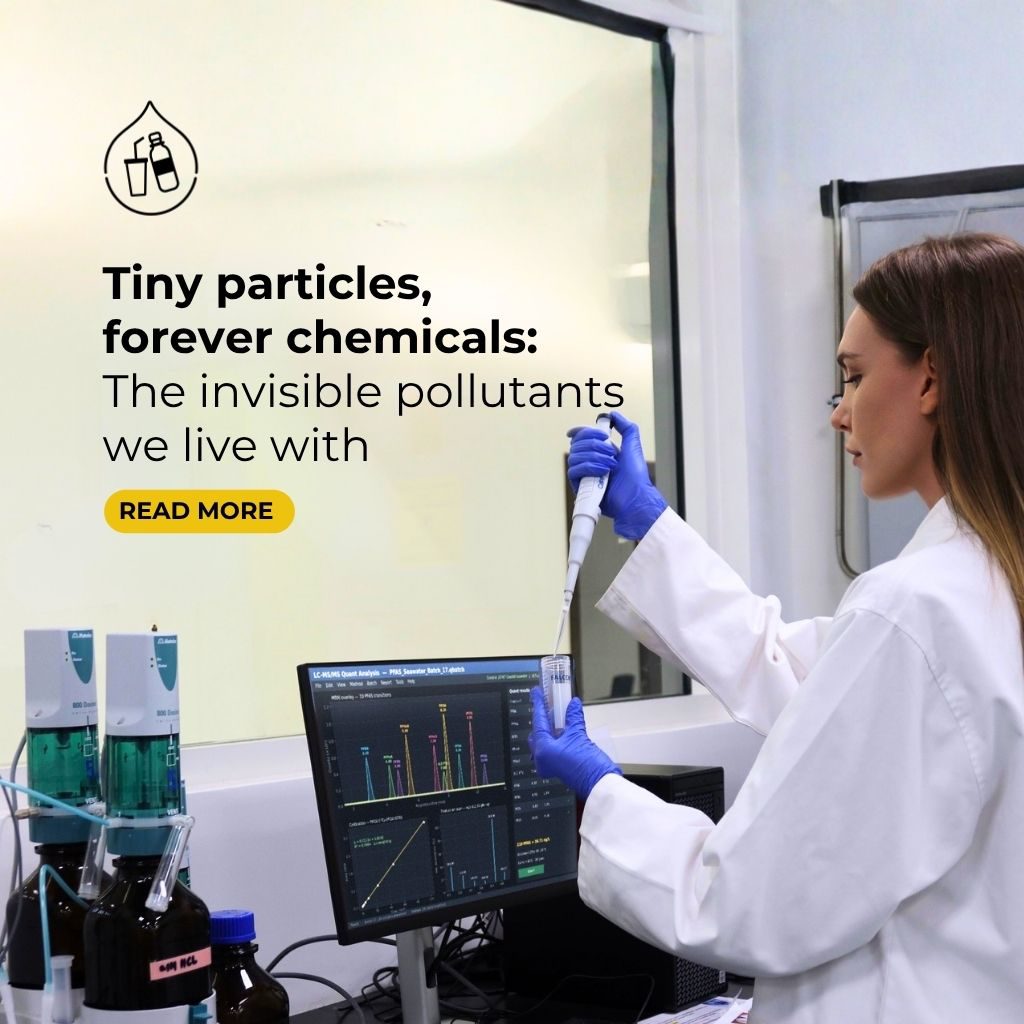
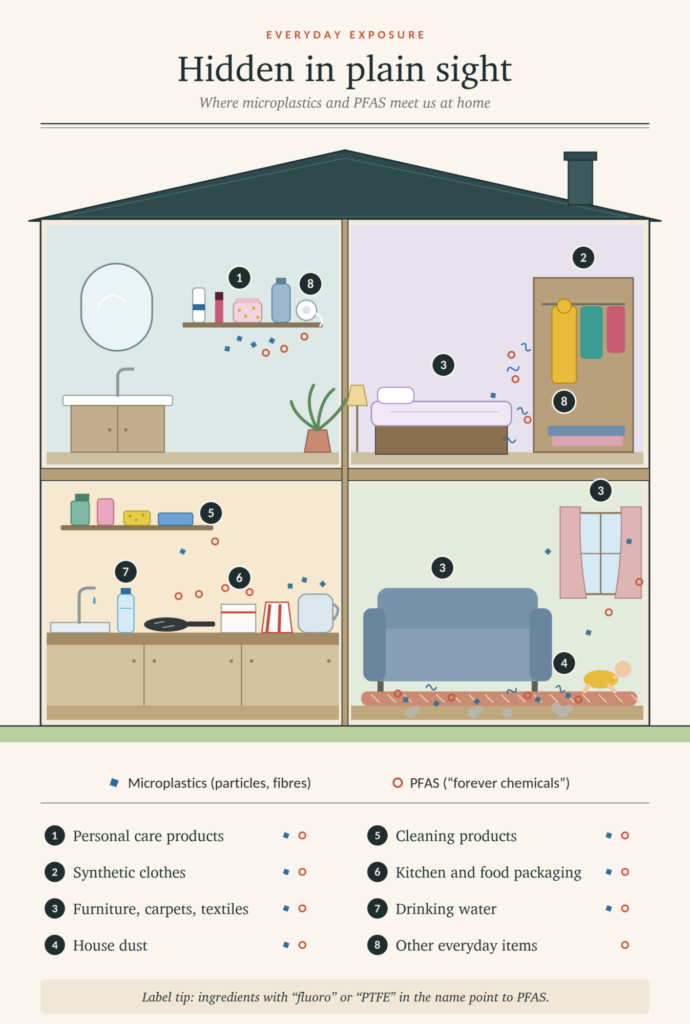
Look around your home for a moment. The blanket on the sofa, the shampoo in the shower, the non-stick pan on the stove, the synthetic clothes in the wardrobe, the takeout container on the kitchen counter. Each one is a small, everyday source of two of the most talked-about pollutants of our time: microplastics and “forever chemicals.” They sound like two separate problems, but the more we study them, the more they look like two sides of the same story. They come from the same products, they travel the same routes, they never really go away, and they end up in the same places: in our bodies and in the sea.
Meet the Invisible Pollutants
Microplastics are tiny pieces of plastic smaller than 5 millimetres. Some are made small on purpose, like the microbeads once common in face scrubs. Most, however, come from bigger items breaking down: a plastic bottle cracking in the sun, a car tyre wearing on the road, or a polyester shirt shedding fibres in the washing machine.
PFAS (per- and polyfluoroalkyl substances) are a family of thousands of man-made chemicals. They are prized because they repel water, grease and stains, and resist heat. That is why they are found in non-stick pans, waterproof jackets, stain-proof sofas, food wrappers and firefighting foams. They are known as “forever chemicals” because the bond between carbon and fluorine at their core is one of the strongest in chemistry. Nature has almost no way to break it.
Why they behave like partners in crime
Microplastics and PFAS may be very different pollutants, but they share several characteristics that make them particularly difficult to tackle. They don’t go away. Plastic breaks into ever-smaller pieces rather than disappearing, while PFAS can persist for years with little degradation. They travel far, moving through air and water and turning up in places far from where they were made or used, from rainwater to Arctic ice and the deep ocean. They can also travel together.Some plastics contain PFAS as additives or coatings, while microplastics can pick up chemicals from their surroundings and transport them through the environment. And they often come from the same everyday sources: synthetic textiles, packaging, furniture and consumer products. Once released, both can be difficult to detect, track and remove, which makes prevention at the source one of our most effective tools.
It starts at home
We often picture pollution as something obvious like smoke rising from factory chimneys, oil floating on the surface of the sea, or plastic waste washing up on a beach. But some of the pollutants we encounter every day are invisible to the naked eye. Microplastics and PFAS can be hiding in the air we breathe, the water we drink and the products we use at home, making them much harder to see, understand and tackle.
What does this mean for our health?
We take microplastics and PFAS into our bodies through the food we eat, the water we drink and the air we breathe. Both have been detected in human tissues and fluids, and some PFAS can remain in the body for years. For PFAS, research has linked exposure to certain types with effects on cholesterol, liver and immune function, as well as reproductive and developmental effects. Some have also been associated with an increased risk of certain cancers; PFOA, one of the most studied PFAS, has been classified as carcinogenic to humans.
The science on microplastics is newer, but studies suggest they may trigger inflammation and oxidative stress and affect several body systems. Children may be particularly vulnerable because their bodies are still developing. There is also growing interest in how the two pollutants interact: microplastics can carry other chemicals, including PFAS, while plastic itself can contain additives with biological effects. We do not yet have all the answers, but what we know so far is enough to take these pollutants seriously.
From our homes to the sea
What goes down our drains does not simply disappear. Washing-machine water, shower water and cleaning water all flow to wastewater treatment plants. These plants can remove a large proportion of microplastics, but they were never specifically designed to deal with them, while PFAS are much more difficult to remove and can remain in treated wastewater and sewage sludge.
In the UAE, we can see this journey from our homes to the sea. Working with colleagues at the American University of Sharjah and the Sharjah Environment and Protected Areas Authority, we found microplastics in more than 95% of 63 stranded sea snakes, the first published study of its kind, with 97% of the particles being fibres, mostly nylon. Similar microfibres dominated our findings in UAE seabirds, while our beach research showed that plastic fragments can also carry heavy metals on their surfaces. The common thread is hard to miss: what leaves our homes can eventually find its way into Gulf wildlife.

What can we do?
We may not be able to eliminate these pollutants from our lives, but we can choose what we bring into our homes and what we send back into the environment. Small changes add up: heat food in glass rather than plastic, choose natural fibres when possible, wash synthetic clothes less often, use a microfibre filter, and look for PFAS-free products. Filter your drinking water, keep indoor dust under control and think twice before choosing stain-resistant or “easy-clean” materials. No single choice will solve the problem, but millions of everyday choices can move us in the right direction. We do not need to be perfect, we simply need to be more conscious of the choices we make.
Two wins with every choice
The good news hidden in this story is that the same choices that protect our health also protect the sea. Every synthetic sweater washed less frequently means fewer fibres released into the environment. Every PFAS-free pan or product is less of a forever chemical in our blood and in the Gulf. Individual action is only part of the solution. Manufacturers need to design products without PFAS and with less plastic shedding, and regulators in the UAE and worldwide are starting to act. But as consumers, we send a signal with everything we buy. Minimise your exposure, and you pollute less at the same time. That is a trade worth making.
Dr. Lara Dronjak is an environmental chemist and postdoctoral researcher at the American University of Sharjah, where she studies emerging contaminants such as PFAS and microplastics in the marine environment of the UAE.
Studies mentioned
- Yaghmour, F., Dronjak, L., et al. (2026). Microplastic ingestion in sea snakes: Examining age-related exposure and regional differences. Journal of Hazardous Materials: Plastics, 2, 100015.
- Yaghmour, F., Al Naqbi, M.J., Kanan, S., Dronjak, L., et al. (2025). Seabirds in a flap: the ingestion of meso/macro marine debris, microplastics and oil/tar by marine and coastal birds in the United Arab Emirates. Marine Pollution Bulletin, 217, 118063.
- Attaelmanan, A.G., Aslam, H., Ali, T., Dronjak, L. (2023). Mapping of heavy metal contamination associated with microplastics marine debris: A case study, Dubai, UAE. Science of the Total Environment, 891, 164370.
