
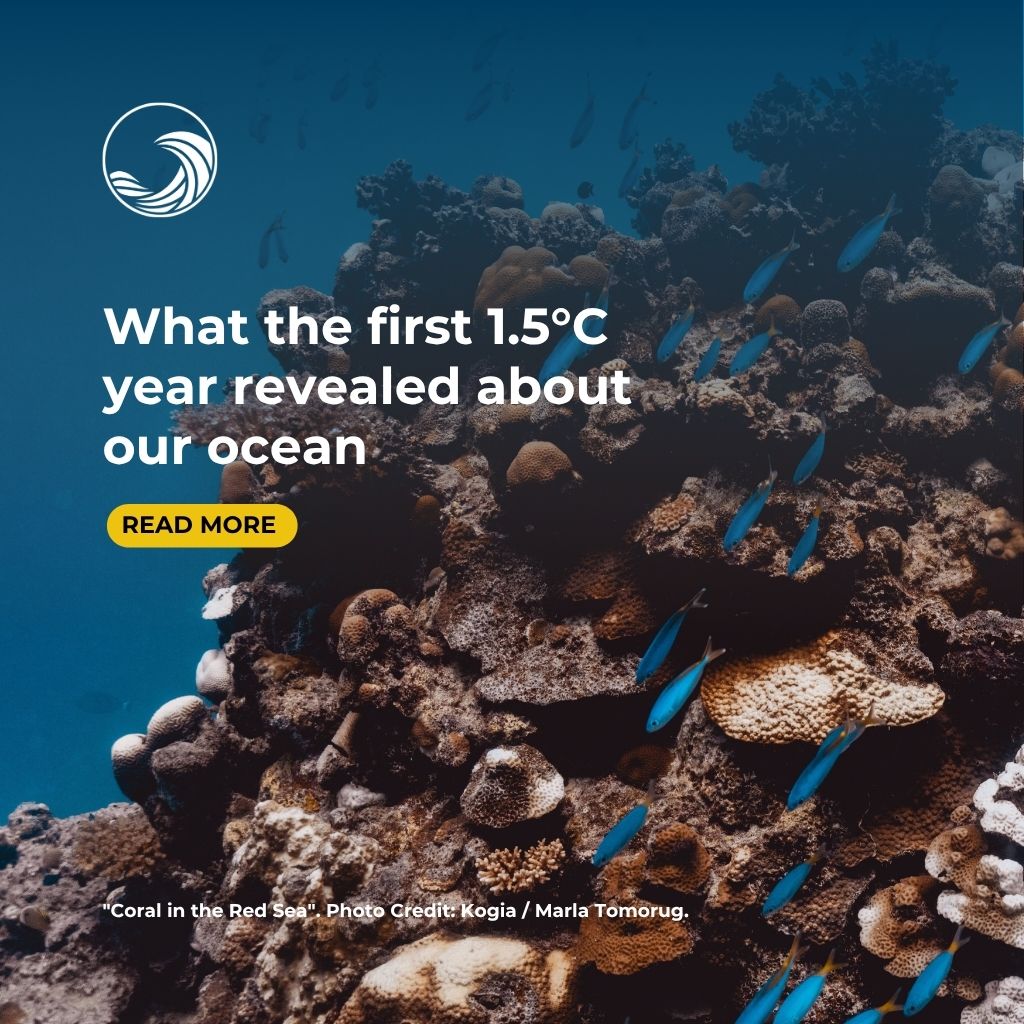
For decades, the 1.5°C milestone has anchored climate negotiations. It is the benchmark embedded in the Paris Agreement, the number governments reference when committing to emissions reductions, the figure scientists use to model tipping points. But until recently, no one had documented, in real time, what was actually happening to ocean ecosystems when the world crossed it.
Between July 2023 and June 2024, global average temperatures temporarily met or exceeded 1.5°C above pre-industrial levels for 12 consecutive months. A landmark study published in One Earth in June 2026, led by researchers at King Abdullah University of Science and Technology (KAUST), has produced the first comprehensive global assessment of how marine life responded during this year. The team, spanning more than 25 scientists working across 17 languages, catalogued 201 ecological impact events from this period – when the ocean surface warmed beyond 1°C above pre-industrial levels for the first time in 170 years of instrumental records.
This study not only establishes how far the consequences extended – it also raises the alarm on the timing of this damage.
Heat extremes without a season
Marine heat stress is usually perceived as follows: summer brings warm water, stressed ecosystems begin to respond, scientists document the damage throughout summer and autumn, after which recovery begins. Some monitoring systems, response protocols, and conservation planning have been built around this seasonal logic.
The 2023–2024 period broke that model entirely. Heat extremes occurred year-round, and ocean surface warming exceeded 1°C above pre-industrial levels for the first time in the 170-year instrumental record. The KAUST study linked ecological disruption to the same pattern: it did not stop when summer ended. Almost a third of impacts outside the tropics occurred in traditionally cooler seasons.
This has profound implications for ocean governance. The study found widespread disruption throughout the year, suggesting that monitoring systems calibrated around seasonal extremes may be missing significant events occurring between them. As lead author Dr. Shannon Klein put it: “One of the clearest findings was that impacts were not confined to traditional summer heat extremes. We found evidence of ecological disruption across seasons, which suggests that understanding and responding to ocean warming requires year-round monitoring and assessment.”
What 201 events look like
The study drew on an unusually diverse evidence base: peer-reviewed literature, government agency reports, environmental monitoring programs, news media, and social media observations, all verified and cross-referenced across 17 languages. The result is one of the most comprehensive records of marine ecological disruption ever assembled for a single year.
Documented impacts ranged from coral bleaching and harmful algal blooms to mass species mortality events, disease outbreaks, harmful algal blooms, habitat loss, and fisheries impacts. Researchers found that 98% of documented ecological impacts were associated with unusually warm sea temperatures. No major marine ecosystem was spared, including places scientists had previously considered safe.
Mass mortality of marine species was documented in more than half of the events studied. Coral bleaching dominated the dataset, accounting for 54 percent of all recorded events. In April 2024, NOAA and the International Coral Reef Initiative confirmed this as the Fourth Global Coral Bleaching Event on record. The proportion of coral-bleaching events reported to involve substantial mortality was almost three times higher than during the previous global bleaching event of 2014–2017. And even more concerningly, 18 of the 50 coral-reef regions globally designated as most resilient to climate change were adversely affected, raising serious questions about existing conservation strategies.
The economic dimension is just as striking. Nearly a quarter of the events directly impacted fisheries and aquaculture, with a single disease outbreak in Norway causing estimated losses of $2 billion USD. Altogether, aquaculture losses tied to these events amounted to roughly 10% of global salmon production for the year.
Why this matters for the MENA Region
The study carries particular weight for the Middle East and North Africa, not least because it was produced at KAUST, on the shores of the Red Sea. Senior author Carlos Duarte, Distinguished Professor of Marine Science and MENA Oceans Advisory Board Member, was direct about the regional stakes: studies such as this help understand those interactions at a global scale while providing knowledge that can support monitoring, conservation, and resilience efforts in regions such as the Red Sea.
While not a finding of the paper, the Red Sea and Arabian Gulf are among the most thermally stressed marine environments on Earth, even under baseline conditions. The Arabian Gulf regularly experiences summer sea surface temperatures among the highest of any coral reef ecosystem globally (Riegl, B. et al., 2026). The Red Sea’s northern waters have historically been considered relatively resistant to bleaching – yet the 2023–2024 period subjected both seas to extremes well beyond historical ranges (HEPCA, Bleach Watch Egypt – February 2024). And regarding the Mediterranean, it recorded heat extreme intensities of roughly 2.5°C to 4°C during the 2023 boreal summer – among the more severe regional anomalies documented globally (Copernicus Climate Change Service, European State of the Climate 2023).
MENA nations are also among those with the most to lose economically. Fisheries, aquaculture, tourism, and the rapidly growing blue economy sectors across the Gulf and Red Sea all depend on marine ecosystem health.
The Monitoring Gap – and the opportunity
Perhaps the most actionable finding of the study is the blind spot it exposes. Many impact assessments still focus on summer, when effects are expected to be most visible and severe. This seasonal focus can create blind spots, especially during exceptionally warm periods. The implication is therefore both scientific and institutional. Governments, conservation agencies, and monitoring bodies that operate on seasonal cycles may be systematically missing events occurring outside them.
For the MENA region, which is still building its marine monitoring infrastructure, this is both a challenge and an opportunity. The architecture being designed now does not need to replicate the seasonal bias of older systems. Year-round observation, including during months traditionally treated as ecologically quiet, should be the baseline.
The researchers are clear that this study is a rapid assessment, not a definitive accounting, and that future validation is needed as impacts continue to unfold. Confirming whether 2023–2024 represents an increase in ecological risk relative to previous years, rather than simply the first year comprehensive enough to be measured, will require formal year-on-year comparison. But they also hope the findings will shape the systems designed to track what comes next – especially the importance of year-round marine monitoring to better understand how ecosystems respond to changing ocean conditions, and to support future conservation and management efforts.
The 1.5°C benchmark was always intended to mark a boundary, a point beyond which consequences worsen and stabilization becomes harder. This study is among the first to show, empirically and in real time, what those consequences look like for the global ocean. For the MENA region, it is a call to build the monitoring capacity, policy frameworks, and conservation strategies that this new reality demands.
Read the full open-access paper: Klein S.G. et al. (2026). Year-round marine heat extremes severely impact marine life during the first year at 1.5°C warming. One Earth. https://doi.org/10.1016/j.oneear.2026.101746
